
III: Horizons
Chapter 10: Monday Begins on Saturday — NIICHAVO as the Ideal Agile Team
Four laws of a self-organizing R&D team from the Strugatsky brothers: meaning as entry filter, dual leadership, specialist against administrator, immersion instead of training. NIICHAVO as a utopia of meaningful labor and a diagnosis of bureaucracy in a team.

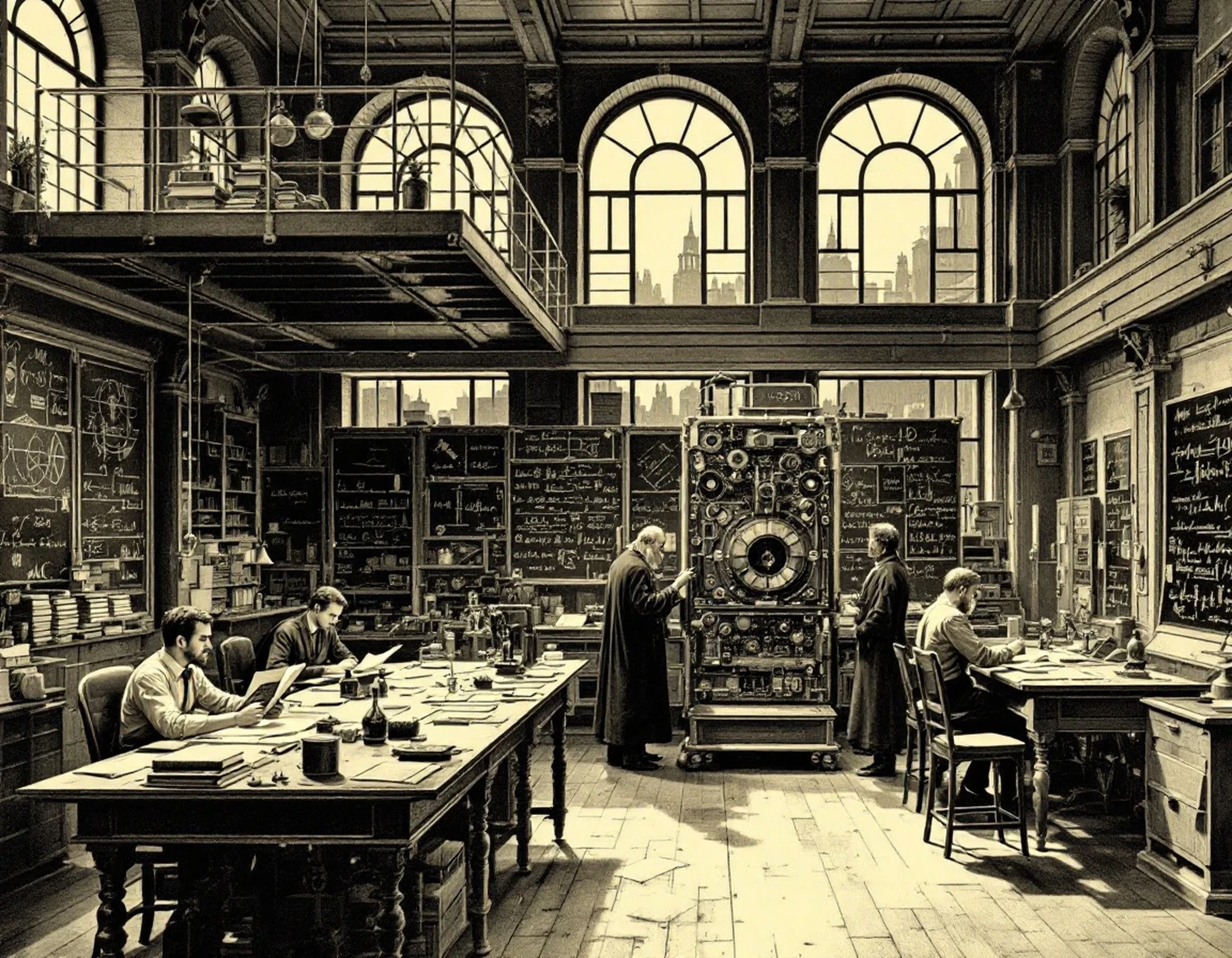
«The most interesting things began in the evening, when the Department of Linear Happiness had finished its work and a particular kind of silence settled over the institute — the silence that exists only in places where, day after day and year after year, people work without sitting on their hands.»
— A. and B. Strugatsky, Monday Begins on Saturday (1965), ch. 1¹
What this chapter is about. Monday Begins on Saturday (1965) is a novel about the Scientific Research Institute for Wizardry and Magic — in the Russian acronym, NIICHAVO.² In his authorial commentaries Boris Strugatsky called it a portrait of «the people we wished we were,»³ and academic scholarship reads NIICHAVO as a utopia of the Soviet scientific-technical intelligentsia:⁴ a place where scientific creativity is not smothered by administrative logic. If one reads the book as a diagnosis rather than as a fairy tale, it yields four laws of a self-organizing R&D team: meaning as entry filter, dual leadership, specialist against administrator, immersion instead of training. In parallel, it shows what destroys such a team (Vybegallo, the methodology theater) and where the team falls when its defensive mechanisms fail (the continuation — Tale of the Troika, 1968).
HOOK: Leningrad — Moscow, 1964
In 1964 the Strugatsky brothers were finishing what they subtitled «a fairy tale for junior scientific workers.»⁵ Boris Strugatsky was an astronomer at the Pulkovo Observatory outside Leningrad; Arkady was a translator from Japanese in Moscow. What they were depicting at NIICHAVO — an institute where wizard-scientists worked on the «meaningful» — was a stylized portrait of what Boris saw every day at Pulkovo, and of what Arkady heard from friends at the academic institutes of Moscow.
The title came out of a writer's notebook. The phrase Monday begins on Saturday refers not to a calendar but to a property of a certain kind of person: for them, work is not separate from life, so Monday begins when the ordinary employee's workweek ends. By the time the brothers finished the manuscript, they realized the story was being written precisely about such people — and the title fell into place.
The book came out from the publisher Detskaya Literatura in 1965 in a print run of one hundred thousand, with illustrations by Yevgeny Migunov. Readers of the time recognized their own research institutes in NIICHAVO. Readers today recognize in it the team they would like to work in — and to lead.
Utopia or Diagnosis?
The standard reading of Monday is escapist fable, Soviet fairy tale for the intelligentsia, nostalgia. The novel resists this reading for two reasons.
First — the authors' own testimony. In Commentaries on What Was Left Behind (2003), Boris Strugatsky describes the intention not as an escape but as an attempt to show «the people we wished we were.»³ They would have wished to be Privalov, Korneev, Edik Amperyan, Gian Giacomo. This is not a fairy tale about wizards — it is a self-portrait of the 1960s scientific-technical intelligentsia in the register of «how we could work, if only they left us alone.»
Second, the structure of the text. If you read only the utopian part (Junta, Kivrin, Privalov, the New Year's Eve shift), you get a fairy tale. But in the same book you meet Modest Matveyevich Kamnoedov — head of the administrative-economic service, who is not a villain but an administrative necessity. And you meet Professor A. A. Vybegallo — a careerist-scientist who imitates science. The Strugatsky brothers show the team AND the forces that destroy it, in one book.
Yvonne Howell, in Apocalyptic Realism (1994), treats NIICHAVO as the place where an entire generation of readers dreamed of working.⁴ A reader today might add: in the same way readers of Rowling dream of studying at Hogwarts. But Hogwarts is a closed school of wizardry. NIICHAVO is an open institute into which an ordinary programmer from Leningrad walks in and discovers that the difference between the utopia and his previous life is administrative-organizational, not ontological.
Monday is not about the team that cannot exist. It is about the team that rarely exists — and why.
Four Laws of a Self-Organizing R&D Team
Law 1. Meaning as Entry Filter
Alexander Ivanovich Privalov, a programmer from Leningrad, is driving his Moskvich on vacation through the Northwest. He picks up two hitchhikers — Volodya Pochkin and Roman Oira-Oira. They bring him to an unremarkable building in the town of Solovets with a sign that reads NIICHAVO. Privalov stays. No interview. Instead, it emerges that he is a programmer — and that the computer interests him more than his own vacation. That is how his people recognize him.
The Strugatsky brothers describe the institute through a single criterion of belonging: for a NIICHAVO employee, the workweek has no beginning and no end. His Monday begins on Saturday because he does not distinguish «work» from «life.» The institute's motto is not a KPI but a mode of existence. That is the entry filter.
Selection by meaning makes command-and-control mechanically impossible. You cannot command a person who does not work by order. Korneev cannot be «assigned a task» — he chooses what he works on, and he works on it around the clock. Gian Giacomo cannot be «given a deadline» — he will finish when the problem is solved. A NIICHAVO employee is built such that a command is an external interference, not a source of work.
Modern equivalents: open-source projects (the Linux kernel, PostgreSQL); the academic laboratories at Bell Labs⁶ and Xerox PARC⁷ in their productive period; early Agile teams before institutionalization — XP at Chrysler's Comprehensive Compensation project in 1996, Spotify squads 2008–2012.⁸ All of them held together by selection, not by discipline. The moment selection weakened and the team was refilled by neutral criteria, the filter blurred — and the work turned into an office.
Law 2. Dual Leadership — A-Janus and U-Janus
The director of NIICHAVO is Janus Poluektovich Nevstruev. He is one man, but in two modes: A-Janus and U-Janus. A-Janus reads time forward: he signs papers, coordinates plans, is responsible for continuity and the executive function. U-Janus reads time backward: he knows what will happen because for him it has already happened, and he brings lessons from future states into current decisions. Every midnight, the modes swap places.
The Strugatsky brothers show: effective leadership of an R&D team requires both modes. Without A-Janus there are no resources, no approvals, no shield from the outside world. Without U-Janus there is no vision, no retrospective, no capacity to see the consequences of decisions before they are made. In a single person, these are combined with difficulty; the brothers therefore made Janus literally two people in one body.
The modern parallel is the CTO/VPE tension in engineering organizations, the split between product lead and tech lead, or the classic startup strain of «make AND ship»: one person rarely holds both registers. Good R&D organizations do not try to fuse them — they divide them explicitly, and give both modes equal legitimacy. Bad ones try to melt them into a single figure, and lose either the retrospective or the execution.
Law 3. Specialist against Administrator — Junta against Kamnoedov
Cristóbal Josévich Junta is the head of the Department of the Meaning of Life. By biography, a former Grand Inquisitor of the Spanish Inquisition. By character, a scientist for whom the internal standard of the work matters more than any external rule. Junta works on problems whose formulation he himself cannot explain to the administration. When Kamnoedov demands a report on results, Junta silently walks out.
Modest Matveyevich Kamnoedov is the deputy director for administrative-economic affairs. Not a villain: the institute needs a man who watches the electrical supply, pays the bills, issues travel orders, reports to the ministry. The Strugatsky brothers do not caricature him. They show something else: the administrative function is necessary, but it must not command the substance.
The law is formulated in one of the most famous scenes. Kamnoedov demands that on New Year's Eve all employees turn in their keys and leave the institute. Junta, Kivrin, Korneev, Edik ignore the order — because at that moment their experiments are running. They are not rebelling. They are working. And their work matters more than an order from the administrative-economic service.
At the same moment enters Vybegallo — a careerist in scholarly clothing. He understands that the administrative class evaluates work by form rather than by content, and he has learned to produce form. His «model of the universal consumer» — the Cadaver, who devours herring and bursts — is a parody of a scientific result, addressed not to colleagues but to superiors and to the press. Vybegallo is a diagnostic figure. He shows what happens to a team when the specialist/administrator balance tilts toward the administration.
The modern equivalent of Vybegallo is the methodology theater. Teams whose Agile rituals (standups, retros, demos) are present but whose content has been lost: the velocity was measured, the OKRs were cascaded, the demo was held, nothing was accomplished. Vybegallo is not a violation of methodology; he is its completion under conditions in which the specialist has yielded to the administrator.
Law 4. Immersion, Not Training — Privalov's Arc
Privalov ends up at NIICHAVO by accident. No one onboards him. No courses, no welcome packets, no mentorship program. He is given a bed in the institute's museum (a hut on chicken legs), access to every floor and every person. Within a few chapters he is already working with the Aldan electronic computer, having sorted out both the problems and the colleagues on his own.
The Strugatsky brothers show: the best R&D teams grow their new members not through lectures but through admission to real work. Privalov learns from Korneev because Korneev is close by and can be interrupted with a question. He learns from Edik because Edik does not refuse to discuss his methodology. He learns from Junta because Junta lets him into his department.
This is what Michael Polanyi (the brother of Karl Polanyi from Chapter 8) called tacit knowledge — knowledge that transmits only through co-presence and cannot be compressed into instructions.⁹ For a newcomer to become part of the team, he does not need to study «the team's methodology.» He needs to be admitted to the work, and to the people who do it. The rest grows on its own.
Modern parallels: the apprenticeship model in research laboratories, «pair programming» in XP, the early Google bootcamps before their formalization. All of them worked as long as one principle held: the newcomer learns not from documentation but from the people beside him doing the real work.
CASE: The Institute's Departments and the New Year's Eve Shift
The institute is built from departments, each with its own logic:
- Department of Linear Happiness (Fyodor Simeonovich Kivrin) — the optimistic applied line, tools of human happiness. The analog of a product team.
- Department of the Meaning of Life (Cristóbal Junta) — fundamental research whose formulations are inaccessible to the administration. The analog of a research function.
- Department of Universal Transformations (Gian Giacomo; Viktor Korneev works here) — deep engineering of matter. The analog of a platform team.
- Computing Center (Alexander Privalov) — a horizontal function serving all departments.
Plus two forces outside the scientific line: Kamnoedov's administrative-economic service (necessary but with guarded borders) and Professor Vybegallo's laboratory, a methodology theater that exists inside the institute as a permanent warning.
Coordination is horizontal. No central planning. No standups. But coordination happens naturally: people meet in corridors, drop into each other's offices, discuss problems at the soda-water machines, interrupt one another with questions, help. Korneev needs Privalov and machine time on the Aldan; Privalov needs Oira-Oira for theoretical consultation; Oira-Oira needs Edik to verify a calculation. A chain forms as needed and dissolves when the problem is solved.
The culminating illustration is the second part, «Vanity of Vanities.» Privalov is on duty at the institute on New Year's Eve. Before leaving, Kamnoedov distributes instructions and reminders. Half an hour after Kamnoedov's departure, all the employees who were «supposed to» leave are found at their workstations: Junta in his laboratory, Korneev with the mages, Edik with his books, Gian Giacomo at his calculations. No one summoned anyone. They are working on New Year's Eve because their experiments are running. Privalov as the formal officer of the day discovers that there is nothing to manage — the institute runs itself.
That is the portrait of a self-organizing team: it holds together not by schedule and not by orders, but by the fact that each person carries inside a task he cannot not work on.
DARK SIDE: What Destroys the Team
In Monday, Vybegallo is a single case in which the balance still holds. In Tale of the Troika (1968)¹⁰ — the continuation of NIICHAVO's story — the balance has already been broken. There, the administrative function fully commands the substance: the Troika for the Rationalization and Utilization of Unexplained Phenomena (an administrative body) rules in Kitezhgrad, the colony of the institute's unexplained phenomena, and decides which investigations are permitted, by criteria of loyalty, reporting, and comprehensibility.
The Strugatsky brothers wrote Troika three years after Monday — and in effect delivered a diagnosis of how the utopia of the previous book decays. The Troika, having seized power over the colony of the institute at Kitezhgrad, decides which phenomena are allowed to exist, by criteria of loyalty, reportability, and comprehensibility. Under the Troika, Vybegallo is a scientific consultant: the methodology theater has become the norm and has been given a title. Privalov and Edik Amperyan, sent from the institute on assignment, get bogged down in meetings, protocols, and regulations. In the Angara journal finale a deus ex machina intervenes: Junta and Kivrin appear and disperse the Troika by the authority of senior mages. But the gesture itself is telling: from inside a system where the administrator has defeated the specialist, there is no way out — an external force is required. This is not an alternative history and not a satire from outside. It is the second act of the same story, told without rose-colored glasses.
What destroys the team according to the Strugatsky brothers:
- Loss of the entry filter — people join the institute by competence and by connections, not by meaning.
- Fusion of the two Januses into one — leadership stops holding the retrospective and loses the ability to learn.
- Victory of the administrator over the specialist — internal craft standards yield to external reporting norms.
- Replacement of immersion by training programs — new members are taught «the team's methodology» instead of being admitted to the work.
- Enthronement of Vybegallo — the methodology theater becomes the criterion of evaluation.
Tale of the Troika is not a prediction. It is the description of a pattern. Any R&D team passes through this scenario if it does not defend itself explicitly.
INSIGHT: A Hierarchy of Decisions for a Self-Organizing R&D Team
From the four laws of the Strugatsky brothers, a practical sequence follows:
- Selection matters more than training. Filter people by how they relate to the work, not by their competence in the moment. Competence is acquired; the relation to work is not.
- Divide the dual leadership explicitly. Assign responsibility for the A-function (execution, resources, defense) and the U-function (retrospective, meaning, direction) to different people. Do not try to combine them in one head.
- Defend the internal craft standards from external control. A knowledge worker is answerable not to reporting but to colleagues and to his own standard. The administrative function is necessary but must not command the substance.
- Immersion, not training. A new member is not taught; he is given access to the work and to the people. Tacit knowledge transmits only in this way.
- Watch for Vybegallo. Notice when form begins to exist without content. Rituals without shipping. Velocity without result. Standup without work. That is the first signal that the specialist/administrator balance has slipped.
The fifth point is the most important, because the destruction of a team rarely happens by an explicit decision. It happens through the gradual accumulation of form without content — until one day the team finds itself living inside Tale of the Troika.
BRIDGE
The Strugatsky brothers show a team that works because it is assembled from people for whom work is life. That is the rare case. But what does one do when such a team did not assemble, the defensive mechanisms have failed, and a crisis is already underway? The final chapter of the book is about work in the mode of a sustained crisis — when a team forms ad hoc and holds together not on meaning and not on love of the craft, but on the discipline of service and the refusal to leave.
Sources and Notes
¹ Strugatsky, A. and B. Понедельник начинается в субботу. Moscow: Detskaya Literatura, 1965, ch. 1. English rendering by the translator: no verbatim English quotation is taken from the standard modern translation by Andrew Bromfield (Chicago Review Press, 2005), which is under active copyright. The opening line was rendered here directly from the Russian original to preserve register consistency across the series (see the copyright-discipline note at the front of this book).
² NIICHAVO is a Russian acronym for Научно-Исследовательский Институт Чародейства и Волшебства — «Scientific Research Institute for Wizardry and Magic.» The acronym has a double life in Russian: read as a word, it sounds close to nichego — «nothing» — a joke about the ostensible product of any bureaucratic research institute. Bromfield's 2005 English edition renders the acronym as NITWiTT to preserve the bilingual pun; this translation retains the Russian transliteration NIICHAVO for reasons of series-wide consistency (see copyright-discipline note above).
³ Strugatsky, B. N. Комментарии к пройденному. Saint Petersburg: Amphora, 2003. The section on Monday Begins on Saturday is the author's reconstruction of the intention behind the novel and of the atmosphere in which it was written in 1963–1964. English rendering by the translator; no standard English edition of Commentaries on What Was Left Behind has been published.
⁴ Howell, Yvonne. Apocalyptic Realism: The Science Fiction of Arkady and Boris Strugatsky. New York: Peter Lang, 1994. An English-language academic monograph on the brothers' work; treats Monday in the context of the utopian aspirations of the Soviet scientific-technical intelligentsia of the 1960s and compares NIICHAVO with other literary «places one would like to live.» This translation quotes Howell verbatim where invoked.
⁵ Biographical details from: Стругацкие. Материалы к исследованию (ed. S. Bondarenko), Volgograd, 2008–2014, vols. 1–9; Skalandis, A. Братья Стругацкие. Moscow: AST, 2008. Boris Natanovich Strugatsky worked at the Pulkovo Observatory from 1955 to 1966. Arkady Natanovich was a translator from Japanese in Moscow. The brothers' joint work was carried out at meetings in Leningrad and Moscow, and through constant correspondence.
⁶ On the practice of Bell Labs in its productive period (1925–1984): Gertner, Jon. The Idea Factory: Bell Labs and the Great Age of American Innovation. New York: Penguin Press, 2012. Gertner's thesis: Bell Labs' success rested not on hierarchy and not on KPIs but on the selection of researchers by their interest in fundamental problems and on horizontal collaboration.
⁷ On Xerox PARC in the 1970–1983 period: Hiltzik, Michael A. Dealers of Lightning: Xerox PARC and the Dawn of the Computer Age. New York: HarperBusiness, 1999. A similar pattern: team selected by meaning, coordination horizontal, destroyed by administrative intervention from the parent corporation.
⁸ Beck, Kent. Extreme Programming Explained: Embrace Change. Boston: Addison-Wesley, 1999. On the Chrysler Comprehensive Compensation project (C3, 1996–2000), ch. 1: XP was formalized on that project, but the team had been working before the methodology was named. Comparative analysis of early Agile teams: Cohn, Mike. Succeeding with Agile. Boston: Addison-Wesley, 2009, part III.
⁹ Polanyi, Michael. The Tacit Dimension. Chicago: University of Chicago Press, 1966. Note: Michael Polanyi (1891–1976), a chemist and philosopher of science, was the brother of Karl Polanyi (1886–1964), the author of The Great Transformation referenced in Chapter 8. These are two different intellectual traditions; confusing the brothers is a common error in the literature.
¹⁰ Strugatsky, A. and B. Сказка о Тройке. First publication: journal Ангара (Irkutsk), no. 4–5, 1968. The full Russian text was published in the USSR only in 1989. The plot continuation of Monday: the same institute several years later under the administrative rule of the Troika for the Rationalization and Utilization of Unexplained Phenomena. Bromfield's English translation Tale of the Troika (Chicago Review Press, 2014) is under active copyright; the reference here is bibliographic only, no verbatim English quotation.