
II: Transformation
Chapter 6: Mina Harker Takes the Notes
The Victorian-era distributed team: phonograph, shorthand, telegraph, and one typewriter against an invisible enemy. The Crew of Light in Bram Stoker as an early prototype of the cross-functional team with a single source of truth.

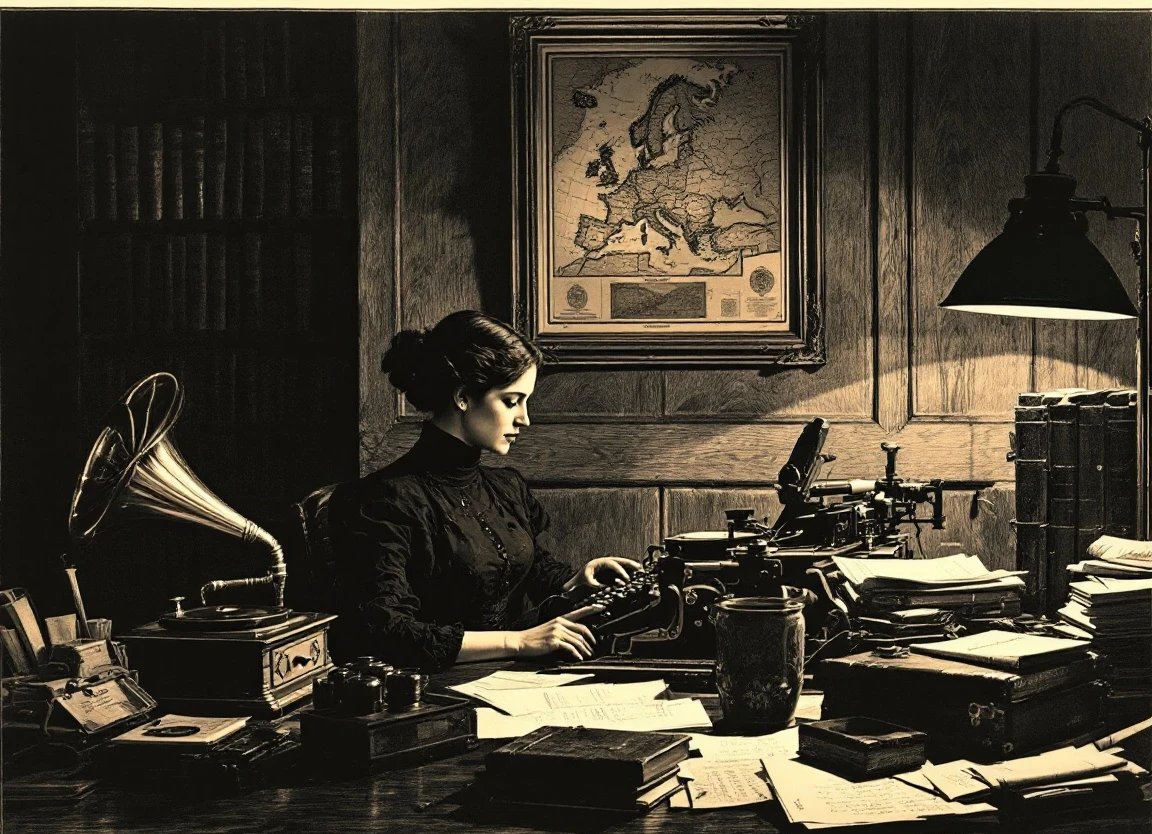
What this chapter does. A distributed team of six people, scattered across London, Whitby, and Transylvania, hunts an invisible enemy in the age before electricity. Their secret weapon is not silver bullets or consecrated wafers, but a Remington typewriter, an Edison phonograph, Pitman shorthand, and one woman who at three in the morning assembles all the scattered diaries into a single document. Six archetypes, four laws of the distributed team, and why Bram Stoker's Crew of Light described — a hundred years before the Agile Manifesto — the very team modern corporations are now scrambling toward.
Purfleet, Dr. Seward's Asylum, Early October 1893
In an office on the second floor of Dr. John Seward's psychiatric asylum — the one that adjoins Carfax Abbey, where a strange foreign count has recently taken up residence — Wilhelmina Harker (Mina to her friends) sits at a Remington typewriter. On the floor beside her, a stack of wax cylinders: Seward's diary, dictated into the Edison phonograph. Nearby, two notebooks in leather bindings — her husband Jonathan's, filled with Pitman shorthand,¹ and her own, in the same system. Beyond those, a bundle of letters from the late Lucy Westenra, a copy of the log of the Demeter, a folder of newspaper clippings (Mina gathered them over two weeks), a series of telegrams between London and Budapest, and a thin sheaf of correspondence from Professor Van Helsing in Amsterdam.
Each fragment on its own is almost nothing. Jonathan's diary describes the captivity in a Carpathian castle, but neither Seward nor Van Helsing has read those pages. Seward's diary records the behavior of the patient Renfield, but no one but Seward himself has listened to the wax cylinders. The newspaper clippings document the delivery of strange wooden crates to London, but no one has yet matched them to Jonathan's description of Carfax. Each held his own shard and did not know that the others held the rest.
This night, Mina sits down for the first time to retype everything into a single document. Jonathan's diaries — with her own transcription of the shorthand into ordinary English. Seward's cylinders — she puts on the phonograph earphones and types from the voice. Lucy's letters, the telegrams, the ship's log, the newspaper clippings — all on one typewriter, on one grade of paper, in one chronological sequence.
According to Mina's diary entry for 30 September, she sets about retyping the whole of the material that night.² By morning she has a document the team can, for the first time, read as a whole. That same evening, in Seward's office after dinner, six people gather around a table and, in her own words, "unconsciously formed a sort of board or committee."³ From this moment the group possesses what it had not: a single source of truth and a common basis for decision.
¹ Stoker does not name the shorthand system explicitly, but by the 1890s Isaac Pitman's system (1837) dominated in England. The alternative Gregg system (1888) took hold in America, where its author moved in 1893, and in Britain of that period was almost never used. See Pitman, Sir Isaac. Stenographic Soundhand (1837). Bath.
² Stoker, Bram. Dracula (1897). Archibald Constable & Co, London. Chapter XVII, Mina Harker's diary, entry of 30 September.
³ Ibid., Chapter XVIII, Mina Harker's diary, entry of 30 September, evening.
Six people and one typewriter.
By the beginning of October 1893,⁴ around Mina a team of six has assembled — known to literary scholars as the Crew of Light, a designation introduced by Christopher Craft in a 1984 essay.⁵ Stoker himself never calls the team by this name; the characters within the text address one another by name and use no collective self-designation. "Crew of Light" is a generalization the criticism offered in hindsight, resting on the novel's through-metaphor: the light of science and joint work against the darkness of an isolated medieval threat.
⁴ The year of the action is not stated explicitly in the novel; the standard dating, based on the alignment of weekdays in the diary entries, is 1893. See Wolf, Leonard. The Annotated Dracula (1975). Clarkson N. Potter, New York.
⁵ Craft, Christopher. "Kiss Me with Those Red Lips": Gender and Inversion in Bram Stoker's Dracula. Representations, no. 8, 1984, pp. 107–133.
The composition of the team is cross-functional by any modern definition:
- Mina Harker — schoolmistress, versed in shorthand and typing, coordinator and analyst;
- Jonathan Harker — solicitor, knows English property law and is the only member of the team who has been inside the Carpathian castle;
- Dr. John Seward — psychiatrist, keeps a phonographic diary, owns the asylum abutting Carfax;
- Arthur Holmwood (Lord Godalming) — aristocrat, provides the money and the social connections for crossing borders;
- Quincey Morris — American adventurer from Texas, versed in firearms and field operations;
- Professor Abraham Van Helsing — Dutch physician and folklorist, the only one capable of recognizing vampirism as a clinical phenomenon.
Six people. Six specialties, none reducible to another. Ages: from the early twenties (Mina, Arthur) to over fifty (Van Helsing). Geography at the outset: London, Exeter, Whitby, Budapest. And one typewriter, on which Mina glues their fragmented experience into a common, readable document.
Stoker published Dracula in 1897, after several years of work begun with research notes in 1890. He did not suspect he was describing an operational model for every team that a hundred and twenty years later would be forced to coordinate remote work through Slack, Confluence, and Zoom. He was writing a Gothic novel about a vampire. In literature it often goes this way: the best management books are written by people who think they are writing about something else entirely. Shelley described creators fleeing their creations. Doyle — the methodology of evidence-based thinking. Verne — iterative development. Stoker describes what modern methodologies will call a single source of truth, a cross-functional team, and asynchronous coordination with synchronous rituals — a hundred and twenty years before any of those terms appear.
The previous chapter showed Cyrus Smith's autonomous team — five men isolated on an island, able to build a civilization from scratch. The isolation worked: the team was compact, bureaucracy did not exist, the crisis gave immediate feedback. But what should a team do that does not have the luxury of isolation? A team whose members are scattered across several cities, with different schedules, different specialties, and different sources of information? A team that must act against an enemy whose tracks show up in fragments — a piece in one person's diary, a piece on another's phonograph, a piece in a third's newspaper clipping?
This chapter is about how such a team is assembled. Which role keeps it from falling apart. And why the Crew of Light — assembled by Mina Harker — explains what has to happen in distributed collaboration, or else the rest of the organizational structure is an empty wrapper.
Van Helsing Is Not the Lone Hunter — His Solitude Kills Lucy
Before we go further — a claim that will disappoint everyone who has watched the Hollywood adaptation.
Abraham Van Helsing is not the lone hunter. That is a marketing wrapper the mass culture pasted onto Stoker's character and made stick — to the point of being cited as the corporate archetype of "the expert-consultant who will come in and save you." The argument runs like this: if Van Helsing is the example of "call the expert, the expert knows," then a team needs one expert who will make decisions for everyone; the others should execute. Coordination, a common knowledge base, general discussion — not necessary. One guru is enough.
The canonical Stoker text says the opposite. Van Helsing, on his own, sustains the heaviest defeat in the novel.
The Case of Lucy Westenra: While the Team Is Not Yet Formed, the Expert Loses
September 1893. Lucy Westenra — Mina's close friend, Arthur Holmwood's fiancée — is slowly fading in Hillingham under the supervision of Dr. Seward. Seward cannot make the diagnosis and summons his old teacher Van Helsing from Amsterdam. Van Helsing arrives, examines the patient, and understands: he is dealing with vampirism. That is the moment of truth. The expert has recognized the threat.
But then Van Helsing commits the error that costs Lucy her life. He does not share the understanding with Seward. Does not explain the diagnosis. Does not warn Lucy's mother. Acts alone — orders garlic, hangs garlands in the sickroom, performs four blood transfusions from four different donors. Each action is justified with vague references to "his method." The team around Lucy (Seward, Arthur, Quincey, Lucy's mother, the servants) carries out instructions but does not understand their meaning.⁶
The result is predictable. Lucy's mother, kept in the dark for the sake of her weak heart, in the morning takes down "the awful strong-smelling flowers" and throws the window open — to air the room. On the critical night, driven out of her mind by the sight of a wolf at the broken window, she tears the garlic wreath from her daughter's neck — and dies on her bed, while the maidservant sleeps, drugged with laudanum. Dracula returns. Lucy dies. Van Helsing tells the team the truth — but after the funeral.
Modern researchers would call this a shared mental model failure⁷: the expert holds critical information in a single head, the others execute commands without understanding the context, and at the moment when a non-obvious decision is required from a non-expert, everything collapses. Van Helsing makes the diagnosis. The mother removes the garlic. Between those two actions — a communication failure that kills both the mother and the patient.
⁶ Stoker, Bram. Dracula (1897). Chapters XI–XII. Detailed analysis of the communication failures around Lucy's death: Auerbach, Nina. Our Vampires, Ourselves (1995). University of Chicago Press, ch. 3.
⁷ Cannon-Bowers, Janis A., and Eduardo Salas (eds.). Making Decisions Under Stress: Implications for Individual and Team Training (1998). American Psychological Association.
The Expert Without a Team
Modern organizations reproduce the same error that Van Helsing made in Hillingham. McKinsey, BCG, and Bain earn tens of billions of dollars a year issuing clients "diagnoses" that the executing employees do not understand and therefore execute wrongly. The CTO who decides the architecture alone and hands it down to the team through short written notes discovers six months later that the team has built something other than what he had in mind — and that fixing it now costs more than building it over. The CISO who holds the threat model in his own head and issues developers a list of "may/may-not" gets a breach through a hole the developers did not close because they did not understand why it should be closed.
Every time, this is the story of Van Helsing in Hillingham. The expert recognized the threat, but did not pass the understanding on. The team followed the instructions. The mother removed the garlic. The patient died.
Why Stoker Chose the Epistolary Form
Dracula is a novel composed entirely of diaries, letters, telegrams, phonographic records, and newspaper clippings. It has no narrator. There is no one who sees everything. Each fragment is written in the hand of one of the participants, at a moment when that participant did not know what the others knew. This is a technical decision — and it is the novel's principal argument.
Stoker could have written Dracula in the third person, as Shelley wrote Frankenstein or Stevenson Strange Case of Dr. Jekyll and Mr. Hyde. He had the choice. He chose the most inconvenient form, one that requires the reader to assemble understanding out of fragments. Why?
Because the novel is about the value of the assembly. About the moment when the fragments come together. About the fact that the breakthrough of understanding happens not with the expert, but with the person who first sees all the fragments at once. With Mina, who has glued the diaries onto the typewriter. From that point in the novel the hunt for Dracula becomes possible. Before that point — Lucy dies.
For a modern team this thought fits into one short line: it is not the expert on his own who creates value. Value is created by the shared visibility of the data. The expert without it is Van Helsing in Hillingham.
Now the anatomy of a team that works.
Four Laws of the Distributed Team
Law One: Single Source of Truth
The Crew of Light would not have stood a chance against Dracula without Mina's typed report. This is not a literary exaggeration but the structural argument of the text. Before the retyping, the team consisted of six people, each holding his own fragment of the truth. After the retyping — six people, each with the shared context.
The modern analog is called single source of truth. Atlassian, on whose platform more than two hundred thousand teams work, describes the principle this way: a team must have one place where the current state of the project lives, and that place must be updated so that any member of the team receives a current answer without having to ask the others.⁸ A Confluence sprint page, a Jira board, the README.md in the root of the repository, a shared Notion document — the specific tool does not matter. What matters is that it is a single one and that the discipline of updating is invested in it.
⁸ Atlassian. Team Playbook materials on single source of truth (atlassian.com/team-playbook, 2023). Author's formulation from the combined sources.
A team without a single source of truth functions on the Hillingham principle. Each person holds a fragment — his own Slack channel, his own Notion document, his own email thread, his own private messages. Requests of the form "what is our current status with X?" are either ignored or produce contradictory answers from different people. Decisions get made on incomplete information. Six months later it becomes unclear who approved what.
Mina solves this problem in one night of work. Modern teams in her place typically need to introduce the role of "information architect," conduct three quarterly strategy sessions, and roll out corporate training on Confluence. Sometimes it works. More often — no, because the problem is not in the tool. The problem is that there is no person who, like Mina, considers it his task to create and maintain the common document. In modern jargon that role is called the "documentation gardener" — a role most companies do not staff, because it "does not bring direct value." The Crew of Light survived because that role existed. Lucy Westenra did not have it.
Law Two: Six Specialties, Zero Formal Hierarchy
Stoker's team is organized surprisingly flat for a Victorian novel. There is an aristocrat (Lord Godalming), a professor (Van Helsing), a solicitor (Jonathan Harker), a physician (Seward), an American adventurer (Morris), and a schoolmistress (Mina). By the social table of ranks in 1893, between them lies an abyss. But no one in the team gives orders.
Decisions are made at "councils" — general discussions in Seward's office, where each speaks. When the team plans the search of Carfax, the final decision comes after discussion, not on Van Helsing's command. When the team must decide whether to keep Mina informed about the further course of the hunt, the team decides "no" — collectively and mistakenly (and the text shows the price of that mistake), but it is shared responsibility, not an order from above. Mina herself participates in the decisions on the same terms as the men — a construction unusual for a Victorian novel, on which the criticism has fastened separate attention.⁹
⁹ Senf, Carol A. The Vampire in Nineteenth-Century English Literature (1988). Bowling Green State University Popular Press. See also Auerbach (1995), ch. 3.
This structure — a flat team of experts with an expert-mentor beside them — repeats in every effective cross-functional team of the twentieth and twenty-first centuries. The Mission Control group that recovered Apollo 13 in 1970 — four engineering disciplines, flight director Eugene Kranz as coordinator, not commander.¹⁰ The team that landed the Curiosity Mars rover at NASA's Jet Propulsion Laboratory in 2012 — seven specialties in one room, voices equal, the mission director a function of coordination, not command.¹¹ The startup teams at the "two pizzas" scale, which Bezos formalized at Amazon: a small group of specialists, direct exchange of information, minimum layers.
¹⁰ Kranz, Eugene. Failure Is Not an Option: Mission Control from Mercury to Apollo 13 and Beyond (2000). Simon & Schuster. Canonical English text used directly.
¹¹ Manning, Rob, and William L. Simon. Mars Rover Curiosity: An Inside Account from Curiosity's Chief Engineer (2014). Smithsonian Books. Canonical English text used directly.
Hierarchy in the Crew of Light appears at exactly one point: when specialized knowledge (vampirology) is required, the team temporarily delegates to Van Helsing — but not as commander, as expert in the particular field. On matters of legal title to Carfax the delegation goes to Jonathan. On matters of American firearms — to Morris. On matters of social connections and finance — to Holmwood. On matters of documentation and shorthand — to Mina. This is distribution by competence, not by status.
Law Three: Telegrams and Meetings, Async and Sync
By the beginning of October 1893 the Crew of Light uses every available communication technology. Letters (delivered across London the same day). Telegrams (London–Budapest in hours). Phonograph (asynchronous dictation of the diary). Shorthand (rapid handwritten notation). Typewriter (multiple legible copies). The railway (physical coordination when a meeting is required). The Kodak Hand Camera, with which Jonathan photographs Carfax — another instrument of asynchronous transmission of information.
Translated into the modern language: they work in a mixed regime — asynchronous by default (async-first), but with synchronous rituals.¹² Telegrams are Slack messages. Letters are email. Phonographic diaries are voice memos. Typewritten copies are shared documents. The train for meetings is a Zoom call, when there is no getting around it. And the rhythm: daily update of the common report, periodic face-to-face gatherings for decisions.
¹² Mullenweg, Matt. Distributed Work's Five Levels of Autonomy. ma.tt blog (2020). A structural description of the async-first organizational model from the founder of Automattic, which runs WordPress.com.
What destroys an asynchronous team is not the absence of technology. The Crew of Light coped without the internet. What destroys it is the absence of the discipline of the common document. If each keeps his own correspondence to himself, the fragments do not come together. Mina's discipline — "everything that arrives is retyped and distributed in the common report" — makes asynchrony workable. Without that discipline an asynchronous team degrades rapidly into four non-intersecting email threads, in which each knows his own quarter and the project drowns in the gaps between them.
Law Four: The Expert as Mentor, Not as Commander
Van Helsing is the most knowledgeable person on the team. Only he is able to recognize vampirism. Only he knows the folkloric and medical means of counteraction. Only he reads in Latin the old treatises he cites. If anyone is entitled to be the leader, it is he.
But Stoker does something strange with that role. Van Helsing speaks in broken English with a heavy Dutch accent, cites Latin abundantly, and frequently breaks into exclamations to God. Modern readers usually take this as a literary device; the twentieth-century criticism has seen in it something deeper — a deliberate lowering of the expert figure.¹³ An expert whose speech requires effort to understand ceases to be an automatic authority. The team is forced to discuss his opinions, to ask again, to check — that is, to bring its own judgment into play.
¹³ Auerbach, Nina. Our Vampires, Ourselves (1995). University of Chicago Press, ch. 3.
The modern analog is called by various names: "principal consultant," "tech lead as enabler," "senior as multiplier." Camille Fournier in The Manager's Path formulates it briefly: the task of a senior engineer is not to make all the technical decisions but to develop the team's ability to make them itself.¹⁴ If after two years of work the senior engineer leaves and the team cannot work without him — this is a failure. If he leaves and the team keeps working — this is a success.
¹⁴ Fournier, Camille. The Manager's Path: A Guide for Tech Leaders Navigating Growth and Change (2017). O'Reilly Media. Canonical English text used directly.
Van Helsing passes this test. When in the finale the Crew of Light pursues Dracula through the Carpathians, splitting into three groups — one led by Van Helsing with Mina in a carriage over the pass, a second by Jonathan with Godalming on a steam launch up the river, a third by Seward with Morris on horseback along the bank — each group is capable of making decisions on its own. The knowledge of vampirism that in Hillingham was held in one head is, by the finale, distributed across the team. Mina did this with her typewriter.
The Dark Side of the Crew of Light
It would be intellectually dishonest to idealize Mina's model. It has serious limitations, and Stoker — to his credit — shows them.
Dependence on one "documentation gardener." If Mina goes down — and she almost does, when Dracula marks her with his own blood — the common document stops being updated. Seward tries to continue her work with the phonograph, but the result is fragmentary. The bus factor of the Crew of Light in the documentation dimension is one. The modern analog: a company whose entire body of knowledge lives in the head of one "technical writer," and which is paralyzed the moment that person goes on vacation.
Information asymmetry as a team error. When the Crew of Light, after Dracula's attack on Mina, decides "not to share operational information with her any further, so as not to put her in danger," the decision turns out to be catastrophically wrong. Mina, cut off from access to the common document, ceases to be an analyst and becomes the team's weak point. Stoker elegantly shows: excluding a team member "for the sake of his safety" makes the whole team vulnerable. This is a direct warning to modern management, which likes to exclude "the not-yet-informed" from the correspondence "so as not to confuse them."
The expert does occasionally lapse into monologue. Van Helsing, for all his mentoring training, in several key scenes falls into lecturing — and the team politely waits for him to finish. This is a familiar pattern: an expert who is technically right but communicationally expensive slows the team down with every explanation. A good team learns to interrupt its seniors. The Crew of Light has not fully mastered that skill.
RESOLUTION: The Imperative of the Crew of Light
The archetype of the Crew of Light is not the story that a single great expert is needed to solve the problem. It is the story that a team that has a common report, shared rules, and distributed knowledge defeats a team that has only an expert.
Stoker wrote Dracula in an era when the industrial revolution first confronted people with the necessity of coordinating the actions of a group scattered across several cities. The telegraph, the phonograph, the typewriter, the train — all of it, instruments without which the Crew of Light would not have existed. And when a modern corporation in 2026 plans how to coordinate a remote team through Slack and Notion, it is trying to solve exactly the same task Mina Harker was solving on a Remington typewriter a hundred and thirty years ago.
That task has no elegant technological solution. There is only discipline — someone has to take the role of Mina. Someone has to sit down every day and glue the fragments into a common document. Not "a couple of minutes to update Confluence," but real work: listen to other people's voice notes, transcribe other people's shorthand, retype, distribute to everyone. It is tiring. It does not bring visible value on the quarterly evaluation. And that is precisely why most teams do not staff the role — and then are surprised that they have "communication problems."
The Crew of Light survived because it had Mina. Lucy Westenra did not have a Mina. The price of the difference is one death.
To be continued. In the next chapter: London, 1886 — Dr. Jekyll, whom everyone sees, and Mr. Hyde, who comes out at night. From a team that put everything into the common document — to an organization that hides half of itself in the basement laboratory.