
II: Transformation
Chapter 7: Doctor Jekyll
Corporate duality from Stevenson to Argyris. Dr Jekyll is the manifesto — corporate values on the meeting-room wall. Mr Hyde is what teams actually do at the third hour of a Friday sprint. Doctor Lanyon is the senior who sees both and does not survive the seeing. Argyris and Schön (1974), Goffman (1959) and Koreiko from The Little Golden Calf.

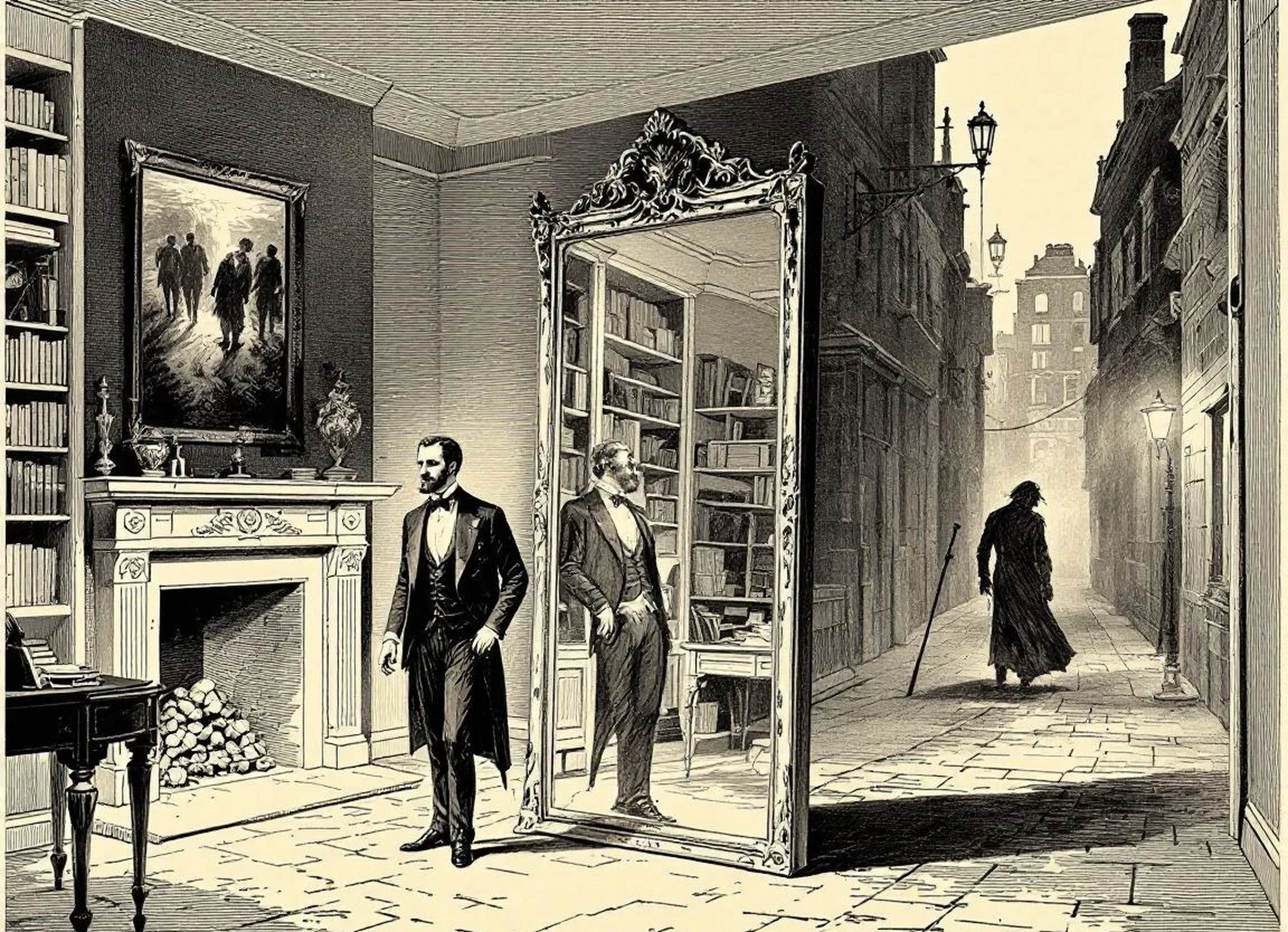
What this chapter is about. Corporate duality from Stevenson to Argyris. Dr. Jekyll is the manifesto — corporate values hung on the meeting-room wall. Mr. Hyde is what teams actually do at the third hour of a Friday sprint, when the deadline is running out and the board is waiting for numbers. Doctor Lanyon is the senior who sees both and does not survive the seeing. Argyris and Schön in 1974 named this gap the split between espoused theory and theory-in-use. Goffman in 1959 described it as the difference between front stage and back stage. And Koreiko from The Little Golden Calf had already played it out on a Soviet street exactly when the American academy was still looking for the terms.
HOOK: Bournemouth, Skerryvore Villa, Autumn 1885
Bournemouth, autumn 1885. Stevenson is bedridden with another lung attack: he is thirty-four, famous after Treasure Island, still short of money. He wakes in the night to his own scream: in the dream a man had taken a powder and become another. «Why did you wake me? I was dreaming a fine bogey tale»¹, he snaps at Fanny. Family legend has it that the first draft was written in three days and burned in the fireplace; Fanny delivered her verdict in writing that her husband had written a scary tale and had missed the allegory. The correspondence tells it more plainly: the work took about six weeks. Either way the outcome was the same: Stevenson sat down and rewrote it. Not a story about a monster, but a story about a man who deliberately kept two lives.
¹ The «fine bogey tale» remark quoted from: Balfour, Graham. The Life of Robert Louis Stevenson (1901). Charles Scribner's Sons, New York. Chapter 15 (per Fanny Stevenson's account).
One detail usually gets missed: Doctor Jekyll is not an exposé of a hypocrite. Stevenson writes it clearly. Jekyll sincerely wants to be a good man, engages in charity, keeps his reputation, does not lie either to himself or to his friends. He takes the potion not out of malice but as a systemic solution: to separate the better side of himself from the worse, so the first could serve society unimpeded and the second could be let out only when no one was watching.
This is not a story about a double agent. It is a story about a double structure — one that at first seems manageable and then ceases to be.
Lanyon Enters the Study
Turn to the ninth chapter of the novella. Stevenson gives it in the form of a sealed letter from Doctor Lanyon — an old friend of Jekyll's, the second most respectable physician in their circle. The letter is addressed to the attorney Utterson with the condition «to be opened after my death or disappearance.» What does this chapter do in the novel? It introduces a witness.
Lanyon receives a strange note from Jekyll asking him to go late at night to Jekyll's house, take out a certain drawer, and bring it home to Cavendish Square. At midnight Lanyon, understanding nothing, receives at his own home an unknown visitor and watches with his own eyes as the unremarkable stranger himself prepares a mixture from the drawer's contents, drinks it, and turns into Henry Jekyll. Lanyon is the only character in the novel who observes the transformation in full, and dies a few weeks later. Not from poison. Not from a blow. Stevenson writes in Lanyon's own voice: «I feel that my days are numbered, and that I must die; and yet I shall die incredulous»².
² Stevenson, Robert Louis. Strange Case of Dr Jekyll and Mr Hyde (1886). Longmans, Green & Co, London. Chapter 9: «Dr Lanyon's Narrative».
Lanyon dies not from what he saw but from the impossibility of telling it. The knowledge he acquired does not fit into any of his professional frameworks. Tell his friends: they will call him mad. Tell his patients: he will lose his practice. Tell the journals: they will laugh him off the podium. Tell no one: he stays alone with a secret exceeding his capacity to bear.
This is the best literary description of corporate burnout known to the author.
Every large company keeps its staff of Lanyons — senior employees who went to one meeting too many, saw both sides (what is said at all-hands and what is said behind the closed door), and now do not know where to put that knowledge. They do not go to HR: HR speaks the language of Jekyll. They do not go to colleagues: colleagues have not yet seen. They do not write anonymous Glassdoor posts: that is career suicide. They keep the knowledge inside, like Lanyon, and six months later hand in a resignation letter explaining their departure as «personal reasons.»
Stevenson catches this phenomenon a century and a half before the corporate psychologists learn to name the departure of conscientious seniors an early symptom of decomposition. Seniors whose standards are highest of all lose their place in a system where inconvenient knowledge has nowhere to go. Only the Hydes remain.
Corporate duality is not the story of one Jekyll. It is a system of three roles: the one who declares the values; the one who actually acts; and the one who sees the gap and does not know where to put it. Stevenson gives us all three. And at the novella's finale not only Jekyll-Hyde dies. Lanyon dies first.
Culture Is Not What Is Written on the Wall
Before we go further — one statement that will upset anyone who has ever prepared a presentation on corporate values.
Corporate culture is not what a company declares in a manifesto, hangs on the meeting-room wall, and reads aloud at onboarding. It is what its employees do when no one is reading it aloud. What the team lead does at the third hour of a Friday sprint when the deadline runs out in forty minutes, the board is waiting for numbers, and one of the «declared values» — for instance, psychological safety — stands in the way of an answer by five o'clock.
In 1974 Chris Argyris and Donald Schön published with Jossey-Bass a book, Theory in Practice: Increasing Professional Effectiveness, which introduced a distinction that has since become the canonical frame for talking about organizations. Espoused theory — what people say they do; theory-in-use — what they actually do. The gap between them is a norm, not a pathology; the only question is its size and the organization's ability to see it³.
³ Argyris, Chris & Donald Schön. Theory in Practice: Increasing Professional Effectiveness (1974). Jossey-Bass, San Francisco. Key terms introduced in chapter 1; the espoused/in-use distinction remains canonical in the organizational-learning literature fifty years on.
The decisive observation of Argyris and Schön is not that the gap exists (anyone who has worked in a large organization already knows that). The decisive one is that people are usually incapable of recognizing their own gap between what they say and what they do. Ask a senior manager: «What do you value in your employees?» He will sincerely answer: «Initiative, open discussion of problems, willingness to challenge management's decisions.» Watch the same manager for three weeks in real work, and you will find that his initiative-taking employees are on his shit list, open problem-discussions collapse within five minutes, and challenging decisions gets you onto a «performance improvement plan», pencilled in with HR.
The most interesting thing is that the manager is not lying. He genuinely believes in his own espoused theory. He does not see the gap. And that is Stevenson's whole point. Jekyll simultaneously believes he is good and regularly turns into someone who walks London and maims passersby, and cannot combine those two facts into one non-contradictory description of his own life. It is not a mask over the face; it is two faces that do not meet in the same mirror.
Front and Back: Goffman Reads Stevenson
Argyris and Schön described the gap for a single individual. But in a corporation not individuals work but groups, and here a second axis of the problem appears. How can one and the same behavior simultaneously be a declaration and its negation? How can Jekyll simultaneously be and not be Hyde?
The answer was given in 1959 by the American sociologist Erving Goffman in The Presentation of Self in Everyday Life⁴. Goffman proposed a theatrical metaphor: every social interaction takes place on a front stage, where participants monitor how they are seen by the audience, and on a back stage, where the mask comes off, the costumes are unbuttoned, the actors smoke and discuss the audience. These two stages are not in competition — they mutually sustain one another: what cannot be discussed on the front is discussed on the back; what cannot be permitted on the back does not appear on the front.
⁴ Goffman, Erving. The Presentation of Self in Everyday Life (1959). Anchor Books, Garden City. The front-stage/back-stage metaphor is introduced in the chapter «Performances»; the model remains foundational in organizational sociology.
A corporation is an institution with two stages by construction. On the front — all-hands meetings, the corporate site, CEO memos, values on the meeting-room wall, the annual report to shareholders, the «About Us» page, the news item in TechCrunch. On the back — the Slack channel #vent (if there is one, and if there is not, the private DMs), the smoking area (or its remote equivalent), the parking-lot conversation after all the meetings, two seniors talking about the new CTO, the phrase «between us.»
Jekyll is the performance on the front stage. Hyde is the same organization in its back-stage mode. And both Stevenson and Goffman emphasize: these are not two different beings. It is one being in two modes. Each of which sustains the other.
Edgar Schein in Organizational Culture and Leadership (1985) adds a vertical dimension to this picture⁵. Any organizational culture exists at three levels. On the surface — artifacts: slogans, dress code, logo, meeting rooms. Deeper — espoused values: what the company says about itself, what it believes as an organization. Deeper still — basic underlying assumptions: what members of the organization consider so self-evident they do not discuss it aloud. And this last level is the most influential. It is precisely the basic underlying assumptions that determine who actually gets promoted, whose criticism is actually heard, which projects actually get resources. The front stage lives at the level of artifacts and values. The back stage — at the level of basic underlying assumptions.
⁵ Schein, Edgar H. Organizational Culture and Leadership (1985). Jossey-Bass, San Francisco. The three-level model — artifacts, espoused values, basic underlying assumptions — persists through every edition of the book, including the fifth (2016).
Now Stevenson becomes a diagnostic instrument. When Jekyll writes in his diary, he works at the level of values: «I conducted the great experiment to free the good side of myself.» When Hyde tramples a child in the street, he works at the level of basic underlying assumptions: «in this world one can act without consequences if one acts fast.» Jekyll's front stage and Hyde's back stage are the same person, but on two of Schein's cultural levels simultaneously.
That is why attempts to change corporate culture by rewriting the manifesto yield nothing. The manifesto lives on Schein's upper level. The real culture lives on the lower one. Rewriting the manifesto is giving Jekyll cosmetic surgery. The Hyde inside does not change.
Three Archetypes of Corporate Duality
Combine Stevenson, Argyris and Schön, Goffman, and Schein into one working scheme. In every large organization there exist three archetypal roles.
Jekyll — the bearer of espoused theory. This is, as a rule, the upper layer of management: CEO, CHRO, communications directors. They sincerely believe in the declared values — most are not cynics but conscientious performers of the front-stage function. Their work is to sustain the coherence of what the company says about itself. Their instruments: corporate communication, mission statements, Glassdoor responses, annual reports.
Hyde — the bearer of theory-in-use. This is, as a rule, the middle and junior layer of doers: the team lead who has to close the sprint; the HR Business Partner who needs to lay off three people by end of quarter; the product manager whose OKR requires shipping a feature that did not pass its UX tests. Hyde knows he is Hyde. He holds no illusions about the gap between the manifesto and what is required of him daily. Hyde is cynically functional: does what needs to be done to keep the dashboard numbers green.
Lanyon — the witness to the split. This is, as a rule, an experienced senior: the principal engineer who has been in the company seven years; the senior analyst with a memory of three reorganizations; the line-of-business director who has survived two CEOs. Lanyon sees both stages simultaneously — he hears what is said at all-hands and sees what is done in sprint planning. The gap is not invisible to him, as it is to Jekyll, and not normalized, as it is to Hyde. It remains an open wound.
And here the pattern of the novella repeats. The open wound heals before the rest of the body.
Four Stages of Cultural Divergence
In work through the late 1970s and 1980s Argyris developed the concept of double-loop learning⁶ — the organization's ability not only to correct actions within existing assumptions (single-loop) but to revise the assumptions themselves. And he described four stages by which an organization loses that capacity.
⁶ The concept of double-loop learning was first formalized in Argyris, Chris & Donald Schön. Organizational Learning: A Theory of Action Perspective (1978). Addison-Wesley, Reading, MA; developed in Argyris, Reasoning, Learning, and Action: Individual and Organizational (1982). Jossey-Bass, San Francisco, and Argyris, Overcoming Organizational Defenses (1990). Allyn & Bacon, Boston.
Stage One: Success on Single-Loop
The company introduces a new value — say, open feedback culture. Runs onboarding, prints posters, organizes trainings. Measures the result through an employee engagement survey: participation in feedback mechanisms has risen. Single-loop learning works: the goal was set, action was taken, the result was measured, the loop closed.
This is Jekyll's first transformation. The potion has been taken, the effect achieved, the diary has recorded the success. Nobody asks the question: «And what did we miss at the next level down?»
Stage Two: Defensive Routines
A year later workers begin to notice a pattern. Those who actually gave negative feedback in the previous cycle got one category lower on the performance review this time. Those who indicated managerial weaknesses in the 360° survey did not get promoted. Those who voiced a structural problem at retro found the problem in their own scope the following quarter.
Nobody puts it in words. But behavior changes. Argyris named such behaviors defensive routines⁷ — invisible rules that protect the system from anyone asking it an uncomfortable question. At the level of artifacts everything is in order: opt-in to feedback mechanisms remains high, NPS has even risen. At the level of basic underlying assumptions openness is no longer possible.
⁷ Argyris, Chris. Strategy, Change, and Defensive Routines (1985). Pitman, Boston. Defensive routines defined as «policies, practices, and actions that prevent embarrassment or threat, but at the same time prevent learning.»
This is Jekyll's second transformation. Hyde no longer appears on the potion's signal. He is held under control — but Jekyll now knows Hyde is there, and spends more and more energy ensuring Hyde does not surface on the front stage.
Stage Three: The Undiscussables
Two years in, themes appear in the company that are formally not forbidden but that nobody discusses. Say, the divergence between the declared work-life balance and the actual expectation of an answer to weekend messages. Or between the declared meritocracy and the fact that promotions go along the line of «friendship with the right people.» These themes become undiscussables — and, more than that, the discussion of undiscussability also becomes undiscussable⁸.
⁸ Argyris, Chris. Overcoming Organizational Defenses (1990). Allyn & Bacon, Boston, chapters 2-3. The phenomenon of «undiscussability of undiscussables» is a key operational characteristic of the defensive organization.
This is the third stage of transformation. Hyde begins to appear without the potion. Not in the sense that the manager accidentally snaps at a subordinate — that is too obvious. In the sense that the manager stops noticing when he switches from front-stage mode to work-mode. They become the same consciousness.
Here Lanyon dies. Specific people leave the company. Not the youngest and not the oldest — exactly the seniors with the highest standards, for whom it is unbearable to be in a system whose main rule is «do not name the main rule.» HR files the departure under «career reasons.» Lanyon, as in Stevenson, keeps the knowledge to himself until the end and leaves no explanation.
Stage Four: Learning to Learn Is Broken
In the final stage the organization loses the capacity for deutero-learning⁹, learning to learn. It does not mean the organization has stopped learning. It means it is incapable of discussing how it learns. Every attempt at retrospective becomes ritual; every culture survey becomes an instrument to optimize the score rather than diagnose the problem; every consulting report on the culture problem meets the reaction «thanks for the recommendations, we already know all this», after which nothing changes.
⁹ The term deutero-learning was introduced by Bateson in 1942 (paper «Social Planning and the Concept of Deutero-Learning,» Conference on Science, Philosophy and Religion, Second Symposium; reprinted in Steps to an Ecology of Mind, 1972, pp. 159-176) and adapted by Argyris for the organizational context — see Argyris & Schön, Organizational Learning II (1996). Addison-Wesley, Reading.
This is Jekyll's finale. In the laboratory study, locked from inside, hearing outside the voices of friends beating at the door. Cannot come out. Not because he does not want to — because there is no longer a version of him that can come out to them. The final Hyde attack is already coming on, and Jekyll writes the last lines of the diary as another person's. Lanyon is dead. Utterson stands at the door not knowing what he will see when they rip it off its hinges.
In the corporation this stage looks like a firm where consultants come and go, new CEOs come and go, the manifesto gets rewritten every three years, yet the operational culture stays the same. Perhaps a bit tougher. Every so often industry outlets publish a piece on this firm's «cultural transformation»; four years later the same outlet publishes a piece on its collapse.
INTERLUDE: Jekyll's Diary as a Corporate Mission Statement
The novella's tenth chapter — «Henry Jekyll's Full Statement of the Case» — is a document written by Jekyll himself retrospectively as an explanation of what had happened. The document is impeccable in form. Every phrase is weighed, every transformation recorded, every ethical choice justified.
And yet it explains nothing.
Jekyll's diary measures the frequency of transformations, dosages, side effects. It does not measure what Argyris would call the only thing that matters — the subject's capacity to discuss his own defensive routines. Every sentence of the diary sidesteps the question «why did I begin?» through an explanation of «how I began.»
Corporate mission statements have the same property. They describe what the company does, without explaining why it does it this way rather than another. They explain values, without showing which practices contradict those values. They take as the zero point what is actually the outcome of many years of defensive routines.
Jekyll's diary is the most honest document in the whole novella, and that is precisely why it is the least diagnostic. A document that the front stage writes cannot diagnose the back stage. Stevenson knew this in 1886.
ANALYSIS: Three Dimensions of the Corporate Hyde
Speed Replaces Judgment
In the scene of Sir Danvers Carew's murder¹⁰ Hyde strikes a passerby with a cane with such energy that the cane breaks and the victim dies without understanding why. It all happens in an instant. Hyde did not deliberate. Did not hesitate. Just struck.
¹⁰ Stevenson, Strange Case of Dr Jekyll and Mr Hyde (1886), chapter 4: «The Carew Murder Case.»
In the corporation that speed looks like this. The performance review cycle has passed, the ratings need to be set by end of week. A senior engineer who was carrying two complex projects did not have time to fill out the self-review properly. The manager does not have time to talk to him — he does not fit in the schedule. The senior gets «meets expectations.» Two weeks later the senior is writing a resume. No one is a villain. No one deliberated. Just the cane struck, and the cane broke.
Hyde is efficient precisely because he does not waste time on nuance. Corporate operational culture is efficient precisely because it does not waste time on seniors who do not fit the template. Espoused theory says: «we value people.» Theory-in-use says: «we value people-related processes performed on deadline.»
Ritual Replaces Work
A ritual is behavior that looks like work but does not lead to work's result. Schein noted that rituals are the most visible and therefore the most protected artifact of culture. They are easy to sustain (all that is needed is a schedule) and impossible to remove (to remove one requires explaining why the ritual does not work, and that requires discussing basic underlying assumptions).
A stand-up at 9:30 for forty-seven people, where nobody asks real questions, is a ritual. A quarterly business review where presentations take a week to prepare and decisions get made on three slides at the end, is a ritual. A retrospective where the same four action items keep getting logged and not one gets closed, is a ritual.
The paradox of ritual is that it simultaneously sustains the espoused theory («we regularly get together to discuss progress») and makes the theory-in-use, which would require real discussion, impossible. Hyde uses ritual as alibi. I was at stand-up. I did not miss retrospective. I reported at QBR. That there was no room in that schedule for the conversation about the real problem is a structural fact, not my fault.
Role Replaces Person
In the novella's finale Stevenson makes an observation that the organizational literature will repeat for the next hundred and fifty years. Reading Jekyll's diary: by the end he stopped being himself and became what his position required him to be. Not Hyde. Not Jekyll. The position.
This is the final stage of corporate duality. Not the split between the person and his mask, not the gap between values and actions, but the disappearance of the person himself under the role. When the CEO says «as your CEO, I have to…», when HR says «I'm just doing my job,» when a manager says «that's the policy» — Stevenson would recognize the formulation. That is how a person speaks who has moved from first person to third, from subject to function.
Koreiko: The Russian Jekyll-Hyde
Ilya Ilf and Yevgeny Petrov in the novel The Little Golden Calf (30 Days magazine, 1931) gave the Soviet image of Doctor Jekyll — one that in places is stronger than Stevenson's, because it works without the potion and without the laboratory¹¹.
¹¹ Ilf, Ilya and Yevgeny Petrov. The Little Golden Calf (1931; magazine serialization in 30 Days; first separate edition 1933). Chapters 4-8 describe the double life of Koreiko at the office «Herkules.» Ilf died 1937; Petrov died 1942; the Russian original is in the public domain (life+70 rule). Anne Fisher's 2009 English translation (Open Letter Press) is the standard modern reference; passages here rendered in the author's own English for voice-register consistency across the series.
Alexander Ivanovich Koreiko — a modest clerk in the office «Herkules,» draws 46 roubles a month, dines humbly with a retired puzzle-maker acquaintance. That is his front stage — a Jekyll of the Soviet type. On the back stage he is an underground millionaire with ten million roubles earned on half a dozen schemes — a Hyde of the same era. What makes Koreiko particularly interesting for our theme is this: both his lives are impeccably executed. The bookkeeping at the office is done without a single error. The underground schemes are organized with engineering precision. The gap between Jekyll-Koreiko and Hyde-Koreiko is sustained more carefully than in Stevenson — because Koreiko has no laboratory. He holds the gap inside one and the same body, one and the same apartment, one and the same biography, and the only thing making the separation possible is absolute discipline: never let them mix.
The plot of the novel is the story of how Ostap Bender tries to crack that gap. Bender is neither a villain nor a moralist — he plays the role of the outside consultant who sees both stages and treats them instrumentally. Koreiko resists not the fact that Bender demands money but the fact that Bender demands he acknowledge that both lives are one life.
Ilf and Petrov's ending is meaner than Stevenson's. Bender extracts the million and discovers there is nowhere in this country to spend it; that same winter he buys foreign currency and gold, and at the Romanian border the border guards strip him bare. And Koreiko? Koreiko burns the dossier, disappears from the scene, and dissolves into the provinces with nine million and both his lives intact. Stevenson killed his double man. Ilf and Petrov let theirs go, and that may be the most precise diagnosis: a disciplined Hyde outlives any Jekyll.
For corporate diagnostics Koreiko is important because he shows: dualism can work stably for years, if the subject has enough discipline to sustain the gap. Most organizational Jekylls of 2026 are arranged exactly this way. Not because they are on the verge of collapse. Because they have Koreiko-level discipline in separating front and back stages. It works — until someone from outside comes in and demands the two lives be fused into one.
REVERSAL: Cynicism as a Defense Mechanism
In the corporate literature it is customary to discuss the cynical employee as a problem — a person who «does not believe in the company's values,» undermines team spirit, requires coaching or removal. Argyris proposed another interpretation¹².
¹² Argyris, Chris. Overcoming Organizational Defenses (1990), chapter 4. Formulation adapted by the author for the cultural-diagnostic context from the book's material.
A cynic is an employee who sees the gap and has no instrument to discuss it. If the gap could be named at retrospective and discussed rationally, the cynic would be first in that discussion. Since it cannot be discussed (undiscussable), the cynic develops the only available behavior — unexpressed, sometimes humorous, sometimes acidic, protest in the corridors. Cynicism is a conversation about the undiscussables held on the back stage.
From this follows a conclusion that any manager finds hard to accept. A high level of cynicism in a team is not a diagnosis of the employees; it is a diagnosis of the manager. Employees who whisper that stand-up says one thing and sprint planning another are not bad employees. They are healthy employees who have identified the gap and have no frame in which to bring the conversation to the front stage.
Ron Westrum in his 2004 typology named three types of organizational culture by how they process bad news¹³. A pathological culture punishes the bearer of the bad news. A bureaucratic culture ignores it or processes it through a procedure. A generative culture thanks him and adapts. Employee cynicism is bad news about the existence of the gap. If there is a great deal of cynicism in a team, the culture is in one of the first two Westrum stages.
¹³ Westrum, Ron. «A Typology of Organisational Cultures.» Quality and Safety in Health Care, vol. 13, supp. 2, December 2004, pp. ii22-ii27. The generative/bureaucratic/pathological typology became the operational frame for all subsequent work on organizational learning, including the adaptation by Forsgren and coauthors in Accelerate (2018).
And here a strange, empirically stable phenomenon appears. Teams with the highest proportion of cynics often turn out to be teams with the lowest level of openly destructive behavior. Cynicism is a defense that keeps the gap from becoming toxicity. First the cynic disappears (leaves for a team with better communication). Then Lanyon disappears (leaves the industry or the role). And then toxicity arrives, because there is no one left to comment on the gap.
CASE: One Morning — When Hyde Comes Without the Potion
Stevenson describes the key turning point of the novella in a single paragraph. Jekyll falls asleep as himself and wakes with Hyde's hands. He looks at his fingers — and sees another's. Small, hairy, predatory. The transformation happened in his sleep, without the potion, without intent, without control.
In organizations the «Jekyll morning» arrives unnoticed. One day the manager discovers that he himself does what the company publicly condemns. Not once — systemically. Not out of anger — by default. And it is not a violation of his values. It is simply what in his role he cannot do otherwise.
Let us gather this moment in one monologue — composite, but each element a reader will recognize:
For three years I said at stand-up that we have an open feedback culture, and I sincerely believed it. Last autumn one of the new hires told me in a 1:1 he disagreed with my architectural decision on the project. I listened to him for twenty minutes, nodded, thanked him. A week later I moved him to another project (unrelated, not disciplinary, formally for business reasons). Six months later he resigned. At the next stand-up I again said we have an open feedback culture, and I again believed it. And at some point on a Saturday I understood: I do not do what I say. Not now, but already for years. All this time. And nobody noticed, because my behavior (that is how it is done here) is that.
That is the Jekyll morning. Not a catastrophe, not a scandal, not a resignation. A quiet morning when you look at your work habits and see another's. Habits you did not choose. Decisions you did not make — more precisely, you were making every day without noticing you were making them.
INSIGHT: The Gap Is Not a Lie, the Gap Is a Diagnosis
Unlike Stevenson's dark finale, the corporate version does not necessarily end in organizational death. Argyris and Schön in that same 1974 book formulate the only possible cure — double-loop learning — the capacity not only to correct actions but to revise the assumptions on which those actions are built.
That means acknowledging one simple thing. Corporate dualism is not a lie. This is not the story of bad people who lie and good people who do not. It is the story of a structure that by its construction produces a gap between declaration and action, and no degree of honesty can close that gap unless it is learned how to discuss it.
The double loop begins with someone at a meeting deciding to say: «What we are discussing right now contradicts what we say publicly.» That is the hardest sentence one can say in a large organization — because it automatically places the speaker in Lanyon's position. He now knows. The knowledge lies on him, and he has let it out.
But the alternative is Stevenson's finale. Lanyon dies, Jekyll locks himself in, Utterson stands at the door and reads the remaining papers when it is already too late. The corporate analog is familiar. The CEO leaves «to spend more time with family,» the new CEO hires new consultants, the manifesto gets rewritten once more, and three years later the same industry commentator publishes the next report.
So — three points for anyone reading this chapter as a guide rather than a literary exercise. First: learn to name the gap. Not fix it, but name it. Any attempt to fix without naming is a manifesto rewrite; Stevenson already wrote about that. Second: do not kill the Lanyons. If a senior with high standards leaves the team, your culture has just lost its most important diagnostic instrument. Ask him what he saw. Third: cynicism is not a pathology; cynicism is a symptom. Do not punish the symptom. Ask what it is trying to tell you.
From Hidden Duality to Open Vision
Stevenson left Jekyll locked in his own laboratory. There was no way for him to come out — because coming out meant acknowledging Hyde was inside and putting that acknowledgment through the front stage. A corporation in the stage of deep dualism is in exactly the same laboratory. The door is locked from inside, and no one from outside can rip it off without violence.
The next chapter is about a character who chose the opposite approach. Not to hide Hyde, but on the contrary to manifest — to see the world as it is not, and act on that vision without minding that everyone around sees otherwise. Don Quixote does not lock himself in a laboratory. He puts on a basin instead of a helmet and rides across the plain of La Mancha on Rocinante, and the only one who sees the world as he does is Sancho Panza — and even then not always.
From Stevenson's closed duality to Cervantes's open vision. From Hyde who hides to giants who are not there. Both answers are an escape from structural seeing of reality. But one hides in the basement, the other rides out over the hill.
«Man is not truly one, but truly two. I say two, because the state of my own knowledge does not pass beyond that point. Others will follow, others will outstrip me on the same lines»
— Robert Louis Stevenson, Strange Case of Dr Jekyll and Mr Hyde (1886)¹⁴
¹⁴ Stevenson, Strange Case of Dr Jekyll and Mr Hyde (1886), chapter 10: «Henry Jekyll's Full Statement of the Case».