
II: Transformation
Chapter 8: Don Quixote and Sancho — The Birth of Team Myth
The finale of Act II. Karl Weick showed in 1995 what Cervantes had shown in 1605: organizations are held together not by org structures and not by procedures, but by a shared story about who they are and where they are going. Four laws of team mythology, three modes (generative, defensive, reconciling), one Russian twin, and one death, in which Sancho weeps not for the loss of a partner but for the loss of a shared meaning.
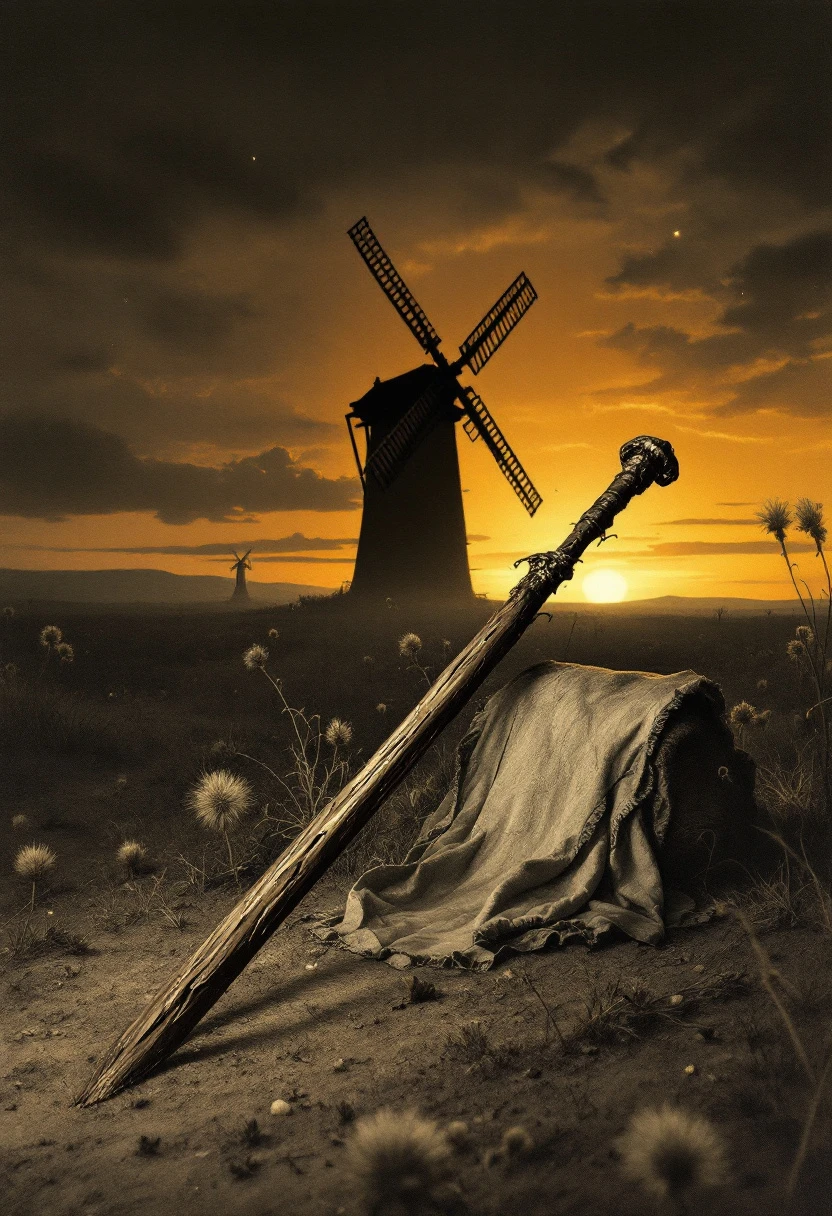
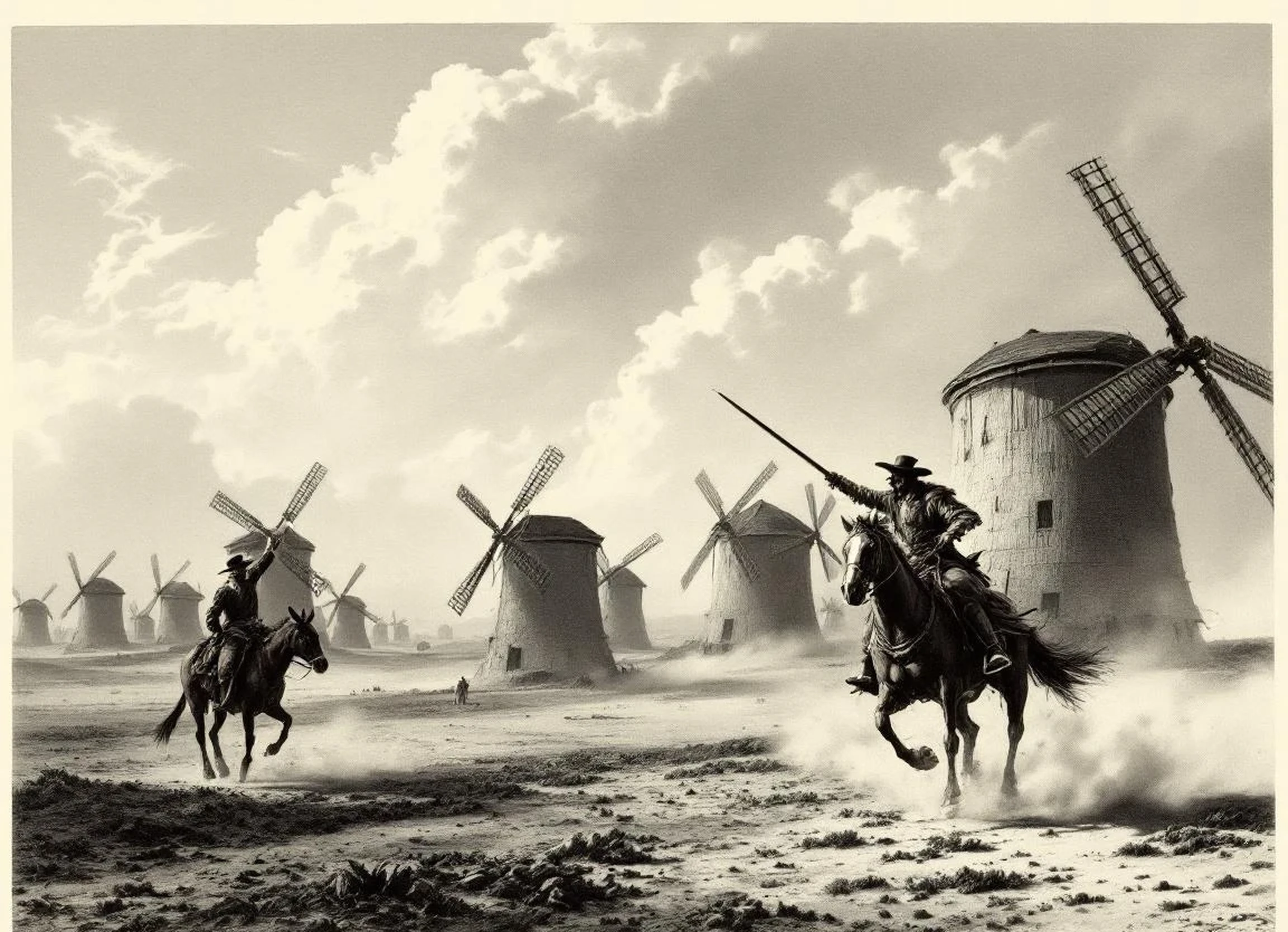
What this chapter is about. The finale of Act II. Karl Weick showed in 1995 what Cervantes had shown in 1605: organizations are held together not by org structures and not by procedures, but by a shared story about who they are and where they are going. The team of Quixote and Sancho is not a madman with a voice of reason beside him but the first literary portrait of team mythology: the visionary composes the challenge, the pragmatist translates the myth into action, windmills turn into giants, action into collective meaning. Four laws of team mythology, three of its modes (generative, defensive, reconciling), one Russian twin, and one death, in which Sancho weeps not for the loss of a partner but for the loss of a shared meaning.
Cervantes, La Mancha, 1605
«At this point they came in sight of thirty or forty windmills that there are on that plain, and as soon as Don Quixote saw them he said to his squire, "Fortune is arranging matters for us better than we could have shaped our desires ourselves, for look there, friend Sancho Panza, where thirty or more monstrous giants present themselves, all of whom I mean to engage in battle and slay"»¹.
For four centuries this scene was read as a comic episode. The madman sees what is not there; the loyal squire points to the obvious; the lance breaks against a sail; the hero falls; the reader laughs.
But Cervantes was not writing a satire on madness. He was describing a phenomenon for which the organizational sciences of his day had no name: the shared story that holds a team in motion. Quixote sees giants not because his mind has slipped — he sees them because he has chosen to see. Forty years earlier he would have spent his life in the library of Alonso Quijano the Good. Now he has a knight's vow, a lance, a helmet-basin — and Sancho. A team of two, held together by a myth.
Sancho sees windmills as windmills. But he goes with Quixote. Not because he believes in giants, but because he believes in the promised island with which Quixote pays him for his service. Sancho has his own version of the shared myth, and it is just as real as the giants. The island is a future one can reach through present actions. If he follows Quixote long enough, the island materializes.
Two men, two interpretive frames, one shared narrative. That is what a team looks like — not on an org chart but in action.
What Actually Holds a Team Together
In the corporate textbooks teams are described as if they were held together by structure. Job descriptions distribute responsibility. KPIs align effort. RACI matrices resolve conflict. Stand-ups synchronize action. If you set up the processes correctly, the team runs like clockwork.
In reality anyone who has worked in a team at all knows: none of the above holds a team together. A KPI can be met formally while remaining alienated from the team. A stand-up can be sat through without saying what matters. A job description is a document nobody has opened since the employment contract was signed.
What holds a team in action lies in another dimension. Karl Weick formulated this in 1995 in the book that became the foundation of modern organizational theory: organizations are systems of collective sensemaking². A team is not a sum of positions but a sum of interpretations. Reality arrives at a team as a stream of ambiguous signals: a drop in conversion, an unhappy customer, a developer who resigned, a piece of news about a competitor. The team survives not by measuring those signals but by turning them into a story: «here is what is happening to us, here is why, here is who we are in this situation, here is where we are going.»
Weick showed on empirical material — from smokejumper crews at Mann Gulch to flight deck teams on aircraft carriers — that in moments when the story breaks, the team breaks too. Not because people got worse but because collective action is in principle impossible without collective interpretation of what is happening. Without the shared story, «doing something» is literally not possible.
Cervantes showed the same 390 years before Weick, only he did it in literature. Quixote without Sancho is a mad librarian who dies in bed. Sancho without Quixote is a peasant who works his patch of land until the end of his life. Together they become a team — because they have a shared myth in which neither of them alone could have believed.
Four Laws of Team Mythology
Read as a theory of organizations, Don Quixote formulates four laws by which team mythology works. They work the same way in 1605 in La Mancha, in 1928 in the Soviet provinces, in 2010 in a Silicon Valley garage, and in 2026 in any meeting room where two or more people are doing something together.
Law One: The Founding Myth
Quixote does not become Quixote right away. Cervantes devotes an entire chapter of Part I to showing how the transformation happens: the fifty-year-old hidalgo Alonso Quijano reads chivalric romances in the library; at some point decides it is not enough to read about deeds — one must perform them; takes the vow; finds his great-grandfather's rusty armor; names the horse Rocinante; christens the neighboring peasant girl Aldonza as Dulcinea del Toboso³. There is no Sancho in this chapter, no windmills. There is only the act of adopting a founding myth: «I am a knight-errant.»
The founding myth is not a story of what a team does but of who it is. In corporate folklore this is «we started in a garage,» «we decided that banking services should be more human,» «we wanted to change how the world looks at clothing.» Edgar Schein in Organizational Culture and Leadership (1985) showed that the founders' obsessions become the basic underlying assumptions of the organizational culture for decades to come⁴. Yvon Chouinard founded Patagonia in 1973 with the myth «we make gear for climbers because we are climbers ourselves.» Half a century later the company's environmental activism still derives directly from that myth — not from strategy, not from ESG fashion, but from the self-definition the founder laid down.
The founding myth is not marketing positioning. Marketing answers the question «what do we sell.» The founding myth answers the question «why are we here at all.» A team without an answer to that question is not a team but a project group temporarily coexisting on a shared calendar.
Law Two: The Visionary-Pragmatist Duo
Cervantes insists that Quixote alone is impossible. Part I begins with a short sally in which Quixote without a squire gets beaten, returns home half-dead, recovers. Only having acquired Sancho does he become the Quixote we know: attacking windmills, freeing galley slaves, disputing the helmet of Mambrino.
This is not a plot accident. Team mythology requires two complementary roles: the visionary who composes the myth, and the pragmatist who leads that myth into collision with reality. The visionary sees giants. The pragmatist sees that the giants have turning sails. The visionary charges. The pragmatist picks up the fallen one and drags him to the inn. Without the visionary the team goes nowhere. Without the pragmatist the team does not survive the first mill.
In corporate history this duo repeats at every major founding: Steve Jobs and Steve Wozniak, Walt and Roy Disney, Larry Page and Sergey Brin, Bill Hewlett and David Packard. One composes the myth — the other makes the myth achievable. When the duo breaks up before the organization reaches maturity, the myth typically either turns into reality without verification (Theranos with its «Edisonian machine» that never worked) or falls apart into pure operations without direction (countless family companies in the second generation).
Sancho is not Quixote's opponent. He is not the voice of reason that debunks the illusion. He is a partner who believes in his own version of the myth — the island. If Sancho considered Quixote simply mad, he would have returned to the pigs after the first windmill. He does not return. He argues with Quixote, corrects him, sometimes laughs at him, but he does not exit the myth. The pragmatist in a team exists not to kill the myth but to translate it into actions the myth will outlive.
Law Three: Adventure as Narrative
Quixote does not merely see giants. He embeds every encounter into a larger story. The windmill is a giant sent by the enchanter Frestón specifically to deprive Quixote of glory. The inn is a castle. The barber with a basin on his head is a knight in the helmet of Mambrino. The galley slaves are prisoners of injustice whom knight-errantry must free. Every encounter finds its place in the narrative Quixote unfolds on the move.
This is not madness. It is the basic work of sensemaking that Joseph Campbell in 1949 described as the monomyth: the recurring structure of the hero's journey into which human cultures have arranged their stories for millennia⁵. The call to adventure. The meeting with the threshold. Trials and allies. The battle with the shadow. The return with the trophy. All working teams, regardless of industry, tell the story of their experience through that structure — because otherwise human consciousness simply does not know how to compose events.
Corporate mythology exploits this structure openly. Quarterly OKRs — «battles.» Competitors — «giants» or «dragons.» A product launch — «adventure.» A customer rescued from a bad experience — «Andrés freed»⁶. Corporate trainers turned this into cliché, but the cliché does not annul the phenomenon. A team that cannot tell the story of its own adventure loses its will to act. That is visible in any project group that has settled into backlog-grooming mode: tasks get done, sprints close, and the sense of movement is gone. The narrative is broken.
Law Four: The Collision of Myth with Reality
The eighth chapter of Part I ends the way any encounter of myth with physics must end: Quixote is broken against the windmill, Rocinante is damaged, the lance is in splinters, the knight lies on the ground. Cervantes does not spare the hero. The giants turn out to be windmills. They were windmills the whole time.
But Quixote does not renounce the myth. He renounces this interpretation of this episode. «Doubtless the same wise Frestón who plundered my study and books has turned those giants into windmills to deprive me of the glory of victory»¹. The myth survives the collision through local rewriting: the enchanter interfered, not I who erred. The team moves on.
Karl Weick described the opposite scenario in a 1993 paper, «The Collapse of Sensemaking in Organizations: The Mann Gulch Disaster»⁷. In August 1949 a team of fifteen smokejumpers landed to fight a forest fire in Mann Gulch canyon, Montana. Within an hour the fire suddenly picked up speed and the team had to run. The foreman Wag Dodge, understanding that outrunning the fire would not work, invented on the spot what did not exist in their training: he set the grass in front of him ablaze, lay down in the burned circle, and waited while the main fire passed him by. He survived. Most of his subordinates died, because they could not renounce the myth «the smokejumper outruns the fire and wins.» Their interpretive frame did not include «lie down in the fire to save yourself.» When reality demanded renunciation of the familiar myth, the myth turned out to be more important than life.
That is the fourth law in its pure form. A myth that cannot be rewritten upon collision with reality kills the team. A myth that renounces itself at every collision also kills the team — because without a myth there is no team at all. Between these two extremes there is a narrow road: the myth is rewritten locally, the shared frame holds, the team moves on. Quixote rewrites the giants into Frestón's magic and rides to the next adventure. Wag Dodge rewrites «smokejumper flees fire» into «smokejumper invents fire against fire» — and lives.
Argyris and Schön would call this double-loop learning⁸: the team changes not only its tactics but its interpretive frame. Most teams cannot manage that. That is why most myths either petrify or shatter.
INTERLUDE: The Helmet of Mambrino, or Collective Interpretation at Work
Chapter XXI of Part I. Quixote sees a horseman wearing a golden helmet. Sancho sees a barber with a copper basin covering his head from the rain. The team draws closer. The barber, alarmed, flees, dropping the basin. Quixote picks up the trophy and declares it the helmet of Mambrino — the legendary helmet of chivalric romance. Sancho laughs: «Sir, that is a basin.» They argue. The resolution is coined by Sancho: what to his master seems a helmet, and to everyone else a basin, he calls a baciyelmo — a basin-helmet, a neologism from the fusion of bacía (basin) and yelmo (helmet)¹. A third frame in which both interpretations live. Several chapters later Cervantes shows the parody of collective agreement: at the inn a company for their own amusement «recognizes» the basin as a helmet — by vote, with straight faces — and the mocking consensus ends in a general brawl. Both scenes are familiar to anyone who has sat in meetings: there is a third frame that lets people work together, and there is a vote that simply nominates a winner.
This is the first scene of collective sensemaking in action in world literature. One object. Two interpretive frames. A group that does not choose one but constructs a third in which both are preserved. This is sensemaking in Weick's sense: not «find the right answer» but «settle on a working version that lets us act together»².
In the corporate reality baciyelmo is encountered daily. A quarterly report: a 3% growth — is this success or failure? The analyst sees the plan met. The marketer sees a loss to the market, which grew 8%. The finance officer sees good conversion of investment compared with competitors. Each is right within his frame. The team does not choose one frame — it constructs a joint interpretation: «a stable result, below potential, requires strengthening of marketing in the next quarter.» That decision is not computed. It is assembled.
A team that knows how to construct baciyelmo survives collisions of myth with reality without decomposition. A team that insists on a single correct interpretation either petrifies in dogma or splits into individual points of view with no connection between them. In the first case the team becomes a sect. In the second — a conglomerate of freelancers passing through a shared calendar.
ANALYSIS: Three Modes of Team Mythology
If a myth holds a team together, it also destroys the team — if it works in the wrong mode. Careful reading of Don Quixote together with the empirical material of modern corporate history yields three stable modes.
Generative mode. The myth organizes action, is tested against reality, is rewritten in collisions, the team moves. Patagonia has held the founding myth «gear for climbers made by climbers» for more than fifty years, but rewrites it at every stage: first the gear, then sustainable production, then legal battles for the environment, then the 2022 transfer of the company to an environmental trust⁹. SpaceX holds together on the myth «multiplanetary civilization»; each Starship test is either a confirmation of the myth or a rewriting of tactics while preserving the frame. The Toyota Production System has held for seven decades on the myth «continuous improvement through respect for the human being»; the frame remains, specific practices are rewritten.
Defensive mode. The myth is used to shield reality rather than to meet it. Theranos held its «Edisonian machine democratizes blood analysis» myth for more than a decade — first while the machine did not work, then while it did not work loudly, then while it did not work catastrophically. The originally strong founding myth had become an instrument of concealment. There was no Sancho to say «Sir, that is a basin.» More accurately: such Sanchos existed — the chief chemist Ian Gibbons; engineers who resigned one after another — but the visionary drove them out or discredited them. A myth without a pragmatic corrector becomes a hallucination¹⁰. WeWork in 2018-2019 held the myth «we elevate the world's consciousness» while the finances said otherwise. The collapse was not unexpected. It was a delayed collision with physics the team refused to stage for itself¹¹.
Reconciling mode. This is the real work of Sancho: not «kill the myth with facts» but «translate the myth into actions the myth will outlive.» When reality brings a challenge, the pragmatist in the team insists not on renouncing the myth but on reviewing the way it is realized. Argyris and Schön described this in the categories of double-loop learning⁸: what changes is not only what we do but why. A team that has both a visionary and a working pragmatist passes through collisions of myth with reality without losing either direction or the connection with physics. In this consists the whole intellectual labor of teamwork — the balance between dogma and cynical operations.
The emotional intelligence described by Daniel Goleman in 1995¹², in this picture, is not a separate skill but an instrument of the reconciling mode. Goleman identified five components: self-awareness, self-regulation, motivation, empathy, social skills. Each of them is about reading what is not expressed directly: nonverbal cues, contextual hints, the emotional state of a partner, unspoken expectations. In terms of team mythology: the reconciling mode requires reading what the myth has not said and what reality has not yet presented in explicit form. A team without this ability either breaks the myth at the first mismatch or ignores reality until catastrophe. A team with it translates each collision into a local revision and moves on.
CASE: Bender and Vorobyaninov — the Russian Team of Quixote and Sancho
Ilf and Petrov in 1928 published a novel that Soviet criticism read as a satire on the NEP-era intelligentsia and then ten years later as a caricature of the emigration. But The Twelve Chairs is first and foremost the story of one team with one myth¹³.
Ostap Bender is a pure visionary. He finds in the former marshal of the nobility Ippolit Matveyevich Vorobyaninov a fragment of information: Vorobyaninov's mother-in-law confessed on her deathbed that she had sewn the family diamonds into the upholstery of one of the twelve chairs of the drawing-room set. The chairs have been requisitioned, dispersed to new owners, scattered across the USSR. Bender immediately mints a myth — chair, diamonds, new life — and the myth organizes the next two hundred pages of action: journeys, cons, impersonations, break-ins, disguises, extractions.
Vorobyaninov is Sancho. He is stingy, pragmatic, attached to the social status he lost after the revolution. He does not believe in the myth wholesale — he believes in the chairs. Diamonds as material objects that can be reached, sold, lived from. But without Bender he would never have dared. Vorobyaninov alone is a former marshal of the nobility spending his days as a clerk in the registry office. Vorobyaninov with Bender is a participant in a great adventure that might still end in the return of what was lost.
The Cervantine structure repeats almost schematically. The visionary composes the myth, the pragmatist translates it into actions, the myth passes through dozens of collisions with reality — failures, chairs lost, competition from a priest who also knows about the diamonds. Each collision is rewritten locally: the myth stays, the tactics change. The team moves.
And the finale — more precise than Cervantes's. In the last chapter Vorobyaninov learns where the twelfth chair is. At night, while Bender sleeps, Vorobyaninov cuts his throat with a razor. He climbs into the club, splits open the last chair — empty. And the caretaker, unsuspecting, cheerfully tells the night visitor a story: in the spring he stood on that chair to change a lightbulb, slipped, tore the upholstery — and stones spilled from under the calico. The diamonds paid for the very club Vorobyaninov is now standing in. The myth is destroyed. The partner is dead. Vorobyaninov loses his mind.
Literary scholarship has spent decades discussing why Ilf and Petrov ended the novel in this way. The version that works in the terms of team mythology: Vorobyaninov does not kill Bender because he grew disenchanted with the myth. He kills Bender precisely because he believes in the myth too strongly — so strongly he is not willing to divide the diamonds. That is, the pragmatist in the team at the last moment turns into a solitary visionary. Sancho becomes Quixote — and at that same moment the myth collapses. The team of two disappears twice: first through the murder of the partner, then through the collapse of the myth itself. The diamonds were in the railway workers' club. They had already been spent. The Russian revolution itself, like a twelfth windmill, turned out to be a windmill: what Vorobyaninov considered a giant challenge was in fact an already accomplished fact past which he had been walking for the last six months without noticing.
Cervantes gave us the perfect visionary who lived to his renunciation and died in his bed — and Sancho sat beside him. Ilf and Petrov gave us the perfect pragmatist who killed his visionary and went mad discovering the myth was empty. Two forms of one and the same truth: a team without a partner is a dead team. Whichever of the two is left alone — he does not survive.
REVERSAL: The Death of Quixote — Separation from the Myth
The seventy-fourth chapter of Part II is one of the saddest scenes in world literature. Quixote returns home beaten, having lost his last combat. He lies down in bed and for several days says: «I was mad, and I am now in my senses; I was Don Quixote of La Mancha, and I am now, as I have said, Alonso Quijano the Good»¹⁴.
The niece and the housekeeper rejoice: uncle has recovered. The priest is pleased: chivalric romances have stopped poisoning his mind. The doctor shakes his head. Everyone around sees a recovery.
Only Sancho weeps. He sits by the bed and begs:
«Ah master, don't die, master, but take my advice and live many years; for the foolishest thing a man can do in this life is to let himself die without rhyme or reason…»¹⁴
Sancho does not understand what Cervantes understood. Quixote is not dying of defeat and not of exhaustion. He is dying of separation from the myth. When he stopped being Don Quixote, his body lost its reason to exist. Alonso Quijano the Good is not a person, he is a name in the parish register. Don Quixote was a person because he lived a knight's life. Without the myth there is no person.
This is not a literary device. It is an empirical observation confirmed every time a team loses its founder — not physically but through separation from the founding myth. Apple between 1985 and 1997, without Steve Jobs, did not die but lost the capacity to produce the things that made it Apple. Volvo after the Ford takeover in 1999 continued to produce cars, but they were no longer Volvos. WeWork after Adam Neumann's ouster in 2019 continued to exist as a legal entity — but the team the myth had held together no longer existed.
Cervantes leaves Sancho the final gesture. The pragmatist weeps not because he lost a salary or an island. He weeps because when Quixote dies, Sancho — the man who passed with Quixote two Parts and a thousand pages — also disappears. What remains is the peasant Sancho Panza, who works his patch of land until the end of his life. Without a partner, without a myth, without action.
The thought to carry away: the myth by which a team lived should not die together with one of the participants. Cervantes showed the death of the myth through the death of the visionary. Ilf and Petrov — through the murder of the visionary by the pragmatist. Both variants lead to one thing: the team is no more.
INSIGHT: Why Teams Actually Exist
Karl Weick's thought can be compressed as follows: management is above all the management of meanings, not of things; things are done by delegation, meanings are done only by the team². This formula could sum up the whole second act of the book.
Phileas Fogg showed iteration as team common sense. Frankenstein — the creator's responsibility for those left behind. Holmes and Watson — the power of analytical partnership. Captain Nemo — the limits of autonomy without collegial correction. Mina Harker — distributed knowledge glued into a single report. Doctor Jekyll and Doctor Lanyon — the split between declared culture and real operations. Don Quixote and Sancho — the mythology that makes the previous six archetypes possible.
All six preceding archetypes work only in a team that has a shared interpretation of what it is doing. Without that interpretation Holmes stays a lonely opium addict, Nemo a misanthrope-terrorist, Mina a secretary with a phonograph, Jekyll a hospital chief leading a double life. The myth is not an addition to teamwork. The myth is its load-bearing construction.
Corporate speech of the last thirty years has treated mythology skeptically. The words narrative, story, meaning, mission have been worn to a state where they trigger reflex eye-rolls. It is an understandable reaction. Mythology is faked more than anything else in corporate communication. But if you strip out the counterfeit myths, what remains is not emptiness. What remains is the real myths on which every working team stands. A team that denies having a mythology is usually simply not accountable for the one it has. Which means its myth either is not reviewed or shatters without conscious defense.
Cervantes and Ilf and Petrov showed two modes of team death: the myth outlived everyone, or the myth was destroyed. The third mode — the myth is alive and being reviewed — literature describes more rarely, because living teams are less interesting to write about. But that third mode is the only place where a team keeps working.
To the Third Act
The second act is done. Eight archetypes, eight dimensions accumulated by the book to this boundary: iteration, responsibility, partnership, measurement without loss of meaning, autonomy, distributed knowledge, corporate dualism, mythology. This is not an exhaustive list — it is eight literary readings through which passes most of what the modern management literature calls «soft skills,» «organizational culture,» and «leadership.»
The third act turns to horizons. What happens to teamwork when the basic conditions of labor change? What outlives the team in a prolonged crisis, when the usual myths no longer work, because there is no one left to listen? What mythological forms will the next generation need when the familiar supports disappear?
Beyond the windows of the office park stands the same windmill of thirty or forty towers. Someone behind one of the panes is right now handing a team its founding myth. Someone behind another is rewriting the myth against a new reality. Someone behind a third is discovering the myth is empty. The windmills turn.
The third act waits.
Footnotes:
¹ Cervantes, Miguel de. Don Quixote de La Mancha (1605). Part I, chapter VIII (windmills episode) and chapter XXI (Helmet of Mambrino). English quoted per John Ormsby's canonical 1885 translation (public domain, Project Gutenberg #996), which this edition uses as its English source for Cervantes, with attribution. Contemporary English translations under active copyright (Edith Grossman 2003; John Rutherford 2000) are not quoted, per the series rule established in chapter 4 note 1.
² Weick, Karl E. Sensemaking in Organizations (1995). Foundations for Organizational Science series, Sage Publications, Thousand Oaks, CA. Foundational work on the theory of organizational sensemaking. See also Weick, Karl E. & Karlene H. Roberts, «Collective Mind in Organizations: Heedful Interrelating on Flight Decks,» Administrative Science Quarterly 38, no. 3 (1993): 357–381 — an analysis of aircraft carrier flight-deck teams as an example of collective mind in organizations with a high cost of error.
³ Cervantes, Don Quixote (1605), Part I, chapters I-II: the library of Alonso Quijano, the adoption of the name Don Quixote of La Mancha, the christening of Rocinante and Dulcinea.
⁴ Schein, Edgar H. Organizational Culture and Leadership (1985). Jossey-Bass, San Francisco. Foundational work on the three levels of organizational culture and on the founders' role in shaping basic underlying assumptions.
⁵ Campbell, Joseph. The Hero with a Thousand Faces (1949). Bollingen Series XVII, Pantheon Books, New York. Concept of the monomyth — the recurring structure of the hero's journey in world cultures.
⁶ Cervantes, Don Quixote (1605), Part I, chapter IV: Don Quixote frees the shepherd boy Andrés from his master, who was beating him. One of the early episodes in which «rescuing the oppressed» becomes part of Quixote's chivalric narrative. The episode ends with an ironic resolution in chapter XXXI of the same first part: the master beat Andrés even harder as soon as Quixote rode away — as the pragmatist Sancho could have predicted.
⁷ Weick, Karl E. «The Collapse of Sensemaking in Organizations: The Mann Gulch Disaster.» Administrative Science Quarterly 38, no. 4 (December 1993): 628–652. An analysis of the disaster of August 5, 1949 in Mann Gulch canyon (Montana, USA): thirteen of the sixteen people in the gorge died; besides Dodge, only two smokejumpers made it over the ridge. Foreman Wag Dodge survived by inventing on the spot a technique of escape fire that did not exist in their training.
⁸ Argyris, Chris & Donald Schön. Organizational Learning: A Theory of Action Perspective (1978). Addison-Wesley, Reading, MA. The concept of double-loop learning is analyzed in detail in chapter 6b (Jekyll & Lanyon), part 2, as applied to corporate dualism.
⁹ Chouinard, Yvon. Let My People Go Surfing: The Education of a Reluctant Businessman (2005). Penguin Books, New York. The founding story of Patagonia in the founder's own words. In September 2022 Chouinard and his family transferred 100% of the company into a trust and a nonprofit dedicated to environmental protection.
¹⁰ Carreyrou, John. Bad Blood: Secrets and Lies in a Silicon Valley Startup (2018). Knopf, New York. The canonical journalistic investigation of Theranos and Elizabeth Holmes, based on interviews with more than 150 sources, including former company employees.
¹¹ Wiedeman, Reeves. Billion Dollar Loser: The Epic Rise and Spectacular Fall of Adam Neumann and WeWork (2020). Little, Brown and Company, New York. A journalistic reconstruction of the WeWork story from its founding through Neumann's ouster.
¹² Goleman, Daniel. Emotional Intelligence: Why It Matters More Than IQ (1995). Bantam Books, New York. The five components of emotional intelligence: self-awareness, self-regulation, motivation, empathy, social skills.
¹³ Ilf, Ilya and Yevgeny Petrov. The Twelve Chairs (1928). First serialized in 30 Days magazine, Moscow, January-July 1928; separate edition Zemlya i Fabrika, 1928. In the sequel The Little Golden Calf (1931) Bender is revealed to have survived: the wound was not fatal, he was saved in hospital. This authorial revision does not annul the literary effect of the Twelve Chairs finale. Ilf died 1937; Petrov died 1942; the Russian original is in the public domain (life+70 rule). Anne Fisher's 2009 English translation (Open Letter Press) is the standard modern reference; passages here rendered in the author's own English for voice-register consistency across the series.
¹⁴ Cervantes, Don Quixote (1615). Part II, chapter LXXIV: «Soy Alonso Quijano el Bueno» / «I am Alonso Quijano the Good.» The scene of Don Quixote's renunciation of the knightly myth and his death. English quoted per John Ormsby's canonical 1885 translation (public domain, Project Gutenberg #996); author's abbreviated rendering above where the Victorian register did not fit the surrounding contemporary prose.