
Intermezzi
Intermezzo I. The Consulting Suite
A satirical diagnosis of the agile theater through Carroll and Bulgakov. A consultancy where forty-three teams, two hundred and eight sprints, and twelve hundred retros a month do not produce a single product. Sprints for the sake of retros, retros for the sake of planning the next sprints. «Seven roles coordinating the work of one person with himself» — and that is called a mature process.
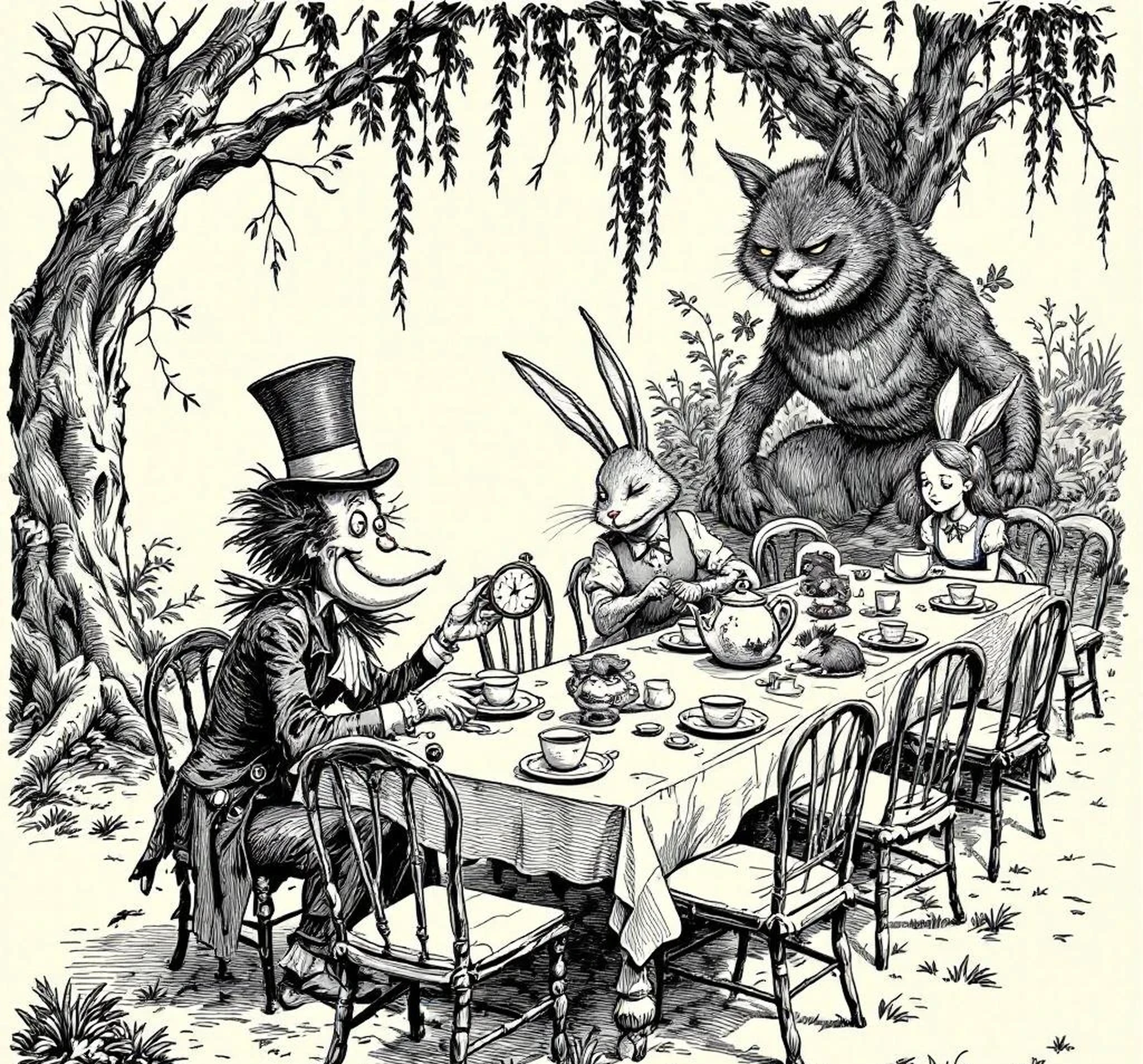
What this intermezzo is about. A satirical diagnosis of the agile theater through Carroll and Bulgakov. A consultancy where forty-three teams, two hundred and eight sprints, and twelve hundred retros a month do not produce a single product. Sprints for the sake of retros, retros for the sake of planning the next sprints. «Seven roles coordinating the work of one person with himself» — and that is called a mature process. A literary mirror for anyone who has ever sat through a Program Increment Planning.
Alice climbed the stairs to the sign «Center for Agile Transformation» in Moscow-City, tower «Federation,» forty-second floor, and found a spacious room with a panoramic view of the Ring Road: precisely the kind of room one expects in a place that transforms everything except results. Around a round table of Karelian birch sat three: an elegant consultant in a Bosco suit, a huge striped cat, and a short man with a nervous tic.
The consultant gestured toward a Herman Miller chair.
«Come in, make yourself comfortable. We were just discussing methodology optimization. You have arrived at the height of our intellectual process. Coffee? We have Illy, the machine cost nine hundred thousand roubles.»
The cat was importantly slicing a caviar sandwich with a knife and fork of German silver, demonstrating the level of operational discipline so rarely encountered in agile teams.
The consultant explained: «Behemoth is our chief technology officer. Korzhikov is our senior Scrum Master, certified, all that. And what is your name?»
«Alice. And what do you do here?»
Korzhikov twitched: the question had evidently caught him in the middle of especially complex reflections on process.
«We roll out agile methodologies! We have forty-three teams, two hundred and eight sprints a month, twelve hundred retros.»
Alice asked with an innocence that in the agile environment is considered bad form:
«And how many products do you ship?»
A silence set in so complete that even the Daikin air conditioning seemed too loud.
The cat purred without looking up from the sandwich: «Sire, the girl is asking the wrong questions.»
The consultant nodded: «Behemoth is right. We measure velocity metrics, burndown charts, story points. Products are waterfall thinking, an outdated approach for those who do not understand modern realities.»
Alice was baffled: «Then why the sprints?»
Korzhikov explained joyfully: «To do retros! And retros so we can plan the next sprint!»
The cat picked up the thread, sipping something clear from a saucer, evidently something bracing to the transformational spirit: «And the next sprint to do retros.»
The consultant added importantly: «This is called continuous improvement. Yesterday we rolled out the SAFe framework. You know, Scaled Agile Framework. Now we have Program Increment Planning every two months.»
«And what do you plan?»
Korzhikov answered: «We plan the planning of the next planning. We have a very complex organizational structure, you see. Tribes, guilds, squads.»
Alice observed: «Like the middle ages.»
The consultant corrected her: «Spotify model, dear. The most modern methodology. Every tribe has its Chapter Lead, every guild has a Guild Master, and they coordinate through a Tribe Lead by way of a matrix reporting structure that provides full transparency of decision-making processes.»
«And how many people are being coordinated?»
Korzhikov answered with pride: «Seven. But we have complete traceability of decision-making processes.»
«Seven people need tribes and guilds?»
The consultant corrected her with the patience of a man who had already explained this many times to investors and audit committees: «Not seven people. Seven roles. People can combine roles. This is called a cross-functional approach. Korzhikov, for instance, is simultaneously Scrum Master, Product Proxy, and acting Release Train Engineer.»
The cat chuckled and began to wash himself with a paw.
«And what do the other four roles do?»
«They coordinate Korzhikov's work with himself,» the consultant explained with the pride of an architect. «We have a very mature collective decision-making process.»
«Sire, wouldn't you like to show the girl our kanban board?»
The consultant waved his hand, and a huge board appeared on the wall: a work of contemporary management art. The columns: «To Do,» «In Progress,» «Code Review,» «Testing,» «Ready for Deployment,» «Blocked,» «Waiting for Approval,» «On Hold.»
Alice admitted: «Beautiful. And what is in the columns?»
«One task,» Korzhikov answered proudly. «"Set up the CI/CD pipeline." Has been hanging for eight months.»
«In which column?»
«In all of them at once,» the cat explained. «We apply the quantum agile approach. The task is in a superposition of all possible states until someone tries to execute it.»
«And has anyone tried?»
«That would violate the Heisenberg uncertainty principle,» the consultant said severely. «We have a dedicated Observer role, who ensures that no one collapses the wave function of our processes.»
«And who is this Observer?»
«Korzhikov,» the cat answered, returning to the sandwich. «He observes himself. A very reflective process.»
Alice looked with confusion at the board, then at the trio at the table.
«What if you tried just to do something useful? Without boards and retros?»
Korzhikov was horrified: «What do you mean, without boards?»
«That is anarchy,» the consultant said severely. «We have processes. Governance. Compliance.»
«And very tasty sausage with breakfast,» the cat added, finishing the sandwich.
Alice carefully stood and headed toward the exit, trying not to disturb the quantum agile balance. Behind her came:
«Korzhikov, begin the retrospective. Let us discuss why the girl did not appreciate our transformation roadmap.»
«And what exactly are we to discuss?» Korzhikov asked himself.
«Well, first,» he answered himself in a different voice, «we shall conduct a stakeholder engagement analysis. Second, we shall document lessons learned in external user communication.»
«And third?» he asked himself in a third voice.
«And third,» all three voices of Korzhikov answered in chorus, «we shall plan a workshop to improve the planning of workshops.»
«And I shall slice more sausage in the meantime,» the cat added. «And create an Epic in Jira called Sausage Initiative with subtasks. Slicing, arrangement, presentation to stakeholders.»
¹ The retinue of Woland (Woland, Behemoth, Koroviev, Azazello, Hella, and Margarita) from Bulgakov, Mikhail. The Master and Margarita (written 1928–1940; first published in Moskva magazine, 1966–1967; complete edition 1969) appears in these intermezzi as a satirical device. Bulgakov died 1940; the Russian original entered the public domain in 2010 (life+70). Character names are given in their canonical English renderings, per Michael Glenny's 1967 translation (Collins), the standard early English version; the Pevear-Volokhonsky (1997) and Karpelson (2006) translations are the standard modern references. Passages here render new dialogue in the author's own English for voice-register consistency across the series; no verbatim quotation from copyrighted contemporary English translations, per the rule established in chapter 4 note 1.